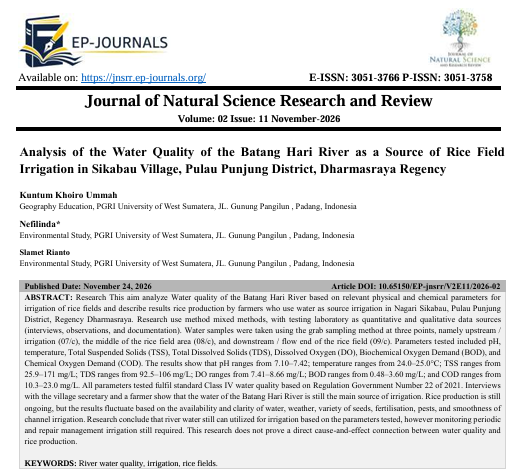
Analysis of the Water Quality of the Batang Hari River as a Source of Rice Field Irrigation in Sikabau Village, Pulau Punjung District, Dharmasraya Regency
DOI:
https://doi.org/10.65150/EP-jnsrr/V2E11/2026-02Keywords:
River water quality, irrigation, rice fieldsAbstract
Research This aim analyze Water quality of the Batang Hari River based on relevant physical and chemical parameters for irrigation of rice fields and describe results rice production by farmers who use water as source irrigation in Nagari Sikabau, Pulau Punjung District, Regency Dharmasraya. Research use method mixed methods, with testing laboratory as quantitative and qualitative data sources (interviews, observations, and documentation). Water samples were taken using the grab sampling method at three points, namely upstream / irrigation (07/c), the middle of the rice field area (08/c), and downstream / flow end of the rice field (09/c). Parameters tested included pH, temperature, Total Suspended Solids (TSS), Total Dissolved Solids (TDS), Dissolved Oxygen (DO), Biochemical Oxygen Demand (BOD), and Chemical Oxygen Demand (COD). The results show that pH ranges from 7.10–7.42; temperature ranges from 24.0–25.0°C; TSS ranges from 25.9–171 mg/L; TDS ranges from 92.5–106 mg/L; DO ranges from 7.41–8.66 mg/L; BOD ranges from 0.48–3.60 mg/L; and COD ranges from 10.3–23.0 mg/L. All parameters tested fulfil standard Class IV water quality based on Regulation Government Number 22 of 2021. Interviews with the village secretary and a farmer show that the water of the Batang Hari River is still the main source of irrigation. Rice production is still ongoing, but the results fluctuate based on the availability and clarity of water, weather, variety of seeds, fertilisation, pests, and smoothness of channel irrigation. Research conclude that river water still can utilized for irrigation based on the parameters tested, however monitoring periodic and repair management irrigation still required. This research does not prove a direct cause-and-effect connection between water quality and rice production.
References
1) Rahman, M., & Mondal, M. S. (2013). Impact of the Bangshi River water quality on irrigated soil and rice in Bangladesh. Asian Journal of Water, Environment and Pollution, 10(1), 129–139. https://doi.org/10.3233/AJW-2013-10_1_11
2) Tekile, A. K. (2023). Suitability assessment of surface water quality for irrigation: A case study of Modjo River, Ethiopia. Journal of Environmental and Public Health, 2023, Article 1482229. https://doi.org/10.1155/2023/1482229
3) Yu, Q., Dai, Y., Wei, J., Wang, J., Liao, B., & Cui, Y. (2024). Rice yield and water productivity in response to water-saving irrigation practices in China: A meta-analysis. Agricultural Water Management, 302, Article 109006. https://doi.org/10.1016/j.agwat.2024.109006
4) Panizzon, J. P., Macedo, V. R. M., Machado, V., & Fiuza, L. M. (2013). Microbiological and physical-chemical water quality of the rice fields in Sinos River's basin, Southern Brazil. Environmental Monitoring and Assessment, 185(3), 2767–2775. https://doi.org/10.1007/s10661-012-2747-1
5) Sazawa, K., Komiyama, T., Tsuchida, T., Taguchi, R., Nakashima, F., Ohta, T., Nishio, M., Yamazaki, Y., & Kuramitz, H. (2023). Effects of paddy irrigation-drainage system on water quality and productivity of small rivers in the Himi region of Toyama, Central Japan. Journal of Environmental Management, 342, Article 118305. https://doi.org/10.1016/j.jenvman.2023.118305 University of Toyama
6) Jayasiri, M. M. J. G. C. N., Yadav, S., Dayawansa, N. D. K., Propper, C. R., Kumar, V., & Singleton, G. R. (2022). Spatio-temporal analysis of water quality for pesticides and other agricultural pollutants in Deduru Oya river basin of Sri Lanka. Journal of Cleaner Production, 330, Article 129897. https://doi.org/10.1016/j.jclepro.2021.129897
7) Pratama, R. A., et al. (2020). A multivariate and spatiotemporal analysis of water quality in Code River, Indonesia. The Scientific World Journal, 2020, Article 8897029. https://doi.org/10.1155/2020/8897029
8) Wahyuningsih, S., Novita, E., Andriyani, I., & Indarto, I. (2021). The analysis of water quality compliance of Jompo River irrigation in Jember Regency. International Journal on Food, Agriculture and Natural Resources, 2(1), 31–34. https://doi.org/10.46676/ij-fanres.v2i1.24
9) Mohamed Hamim, N., Shahrun, M. S., Jaafar, J., Abdul Halim, A., & Juneng, L. (2025). Seasonal variation of irrigation water quality in Bachok, Kelantan. International Journal of Integrated Engineering. https://journal.uthm.edu.my/index.php/ijie/article/view/17930
10) Pahira, S. H., & Rinaldy, R. (2026). Heavy metal accumulation in rice paddy soils and grains irrigated with polluted river water in Indonesia. EQA—International Journal of Environmental Quality, 72, 57–64. https://doi.org/10.60923/issn.2281-4485/22603
11) Abdel-Fattah, M. K., Abd-Elmabod, S. K., Aldosari, A. A., Elrys, A. S., & Mohamed, E. S. (2020). Multivariate analysis for assessing irrigation water quality: A case study of the Bahr Mouise Canal, Eastern Nile Delta. Water, 12(9), 2537. https://doi.org/10.3390/w12092537
12) Bhattacharya, A., Dey, P., Gola, D., Mishra, A., Malik, A., & Patel, N. (2015). Assessment of Yamuna and associated drains used for irrigation in rural and peri-urban settings of Delhi NCR. Environmental Monitoring and Assessment, 187(1), 4146. https://doi.org/10.1007/s10661-014-4146-2
13) Jahin, H. S., Abuzaid, A. S., & Abdellatif, A. D. (2020). Using multivariate analysis to develop irrigation water quality index for surface water in Kafr El-Sheikh Governorate, Egypt. Environmental Technology & Innovation, 17, 100532. https://doi.org/10.1016/j.eti.2019.100532
14) Mandal, S. K., Dutta, S. K., Pramanik, S., & Kole, R. K. (2019). Assessment of river water quality for agricultural irrigation. International Journal of Environmental Science and Technology, 16(1), 451–462. https://doi.org/10.1007/s13762-018-1657-3
15) Misaghi, F., Delgosha, F., Razzaghmanesh, M., & Myers, B. (2017). Introducing a water quality index for assessing water for irrigation purposes: A case study of the Ghezel Ozan River. Science of the Total Environment, 589, 107–116. https://doi.org/10.1016/j.scitotenv.2017.02.226
16) Singh, G., Patel, N., Jindal, T., Ranjan, M. R., Pal, S., & Ahirwal, J. (2022). Hydrochemical characteristics and water quality indices-based assessment of River Kali for agricultural irrigation in northern India. Irrigation and Drainage, 71(2), 510–520. https://doi.org/10.1002/ird.2654
17) Singh, S., Ghosh, N. C., Gurjar, S., Krishan, G., Kumar, S., & Berwal, P. (2018). Index-based assessment of suitability of water quality for irrigation purpose under Indian conditions. Environmental Monitoring and Assessment, 190(1), 29. https://doi.org/10.1007/s10661-017-6407-3
18) Anyango, G. W., Bhowmick, G. D., & Bhattacharya, N. S. (2024). A critical review of irrigation water quality index and water quality management practices in micro-irrigation for efficient policy making. Desalination and Water Treatment, 318, 100304. https://doi.org/10.1016/j.dwt.2024.100304
Downloads
Published
Issue
Section
License
Copyright (c) 2026 Kuntum Khoiro Ummah, Nefilinda, Slamet Rianto (Author)

This work is licensed under a Creative Commons Attribution 4.0 International License.