The Impact of the Earthquake Disaster on the Lives of the Community in Nagari Malampah, Pasaman Regency
DOI:
https://doi.org/10.65150/EP-jnsrr/V2E8/2026-03Keywords:
Disaster, Earthquake, CommunityAbstract
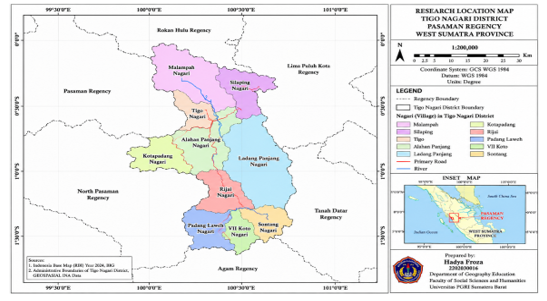
Give description comprehensive about activity research conducted in a brief way. The earthquake that occurred on February 25, 2022, in the Regency of Pasaman give impact big to life community, especially in Malampah Village. This disaster caused damage to infrastructure, disruption activity economy, change eye livelihood, a decline in income, as well as changes in the social community. Research this aim for now impact earthquake earth to eye livelihood, income and life social community in Nagari Malampah, Pasaman Regency. The research uses a mixed-methods approach with a sequential explanatory design, namely combine approach of quantitative and qualitative methods. Data were collected through observation, interviews, documentation, and a dissemination questionnaire to the public affected by the earthquake. Qualitative data were analysed using the Miles and Huberman model, while the quantitative data analyzed in a way descriptive using the Achievement Level Respondents (RAL). Research results: 1). The impact of the earthquake earth to eye livelihood of the public shows that disaster earthquake earth has cause enough change to eye livelihood of the people of Nagari Malampah. Based on interview results, damage land agriculture, plantations, and means of economic support causes part of the public to lose their main livelihood or experience decline chance work. Conditions the push public for look for work additionally, to be laborer daily, or do work side job as a strategy for fulfil need life post-disaster (2). Impact earthquake earth to income public show that condition income public experience decline, although start shows the recovery process. On the indicator income low, still there is grains statement that obtains RAL value of 41.66% (very low) good), whereas indicator other is in the category not enough Good until Enough Good with value of 66.00%–74.66%, which indicates Still existence communities experiencing difficulty economy post-earthquake. Furthermore, on the indicator income medium, all RAL values are in the range of 76.33%–86.00%, so that including category Enough Good until good. This is show that part public start capable restore condition the economy, even though recovery the Not yet evenly. Meanwhile that, indicator income tall own RAL value between 76.66%–78.66% with category Enough good, which indicates that only part the community that has capable increase or maintain his income after disaster, whereas part other Still face constraint consequence damage land, disturbance activity economy, and the reduction chance Work.
References
1) Chopra, A. K. (2020). Dynamics of Structures: Theory and Applications to Earthquake Engineering (5th ed.). Pearson.
2) Chowdhury, J.R., & Parida, Y. (2023). Flood shocks and post-disaster recovery of households: An empirical analysis from rural Odisha, India. International Journal of Disaster Risk Reduction, 97, 104070.
3) Hall, R. (2012). Late Jurassic–Cenozoic reconstructions of the Indonesian region and the Indian Ocean. Earth-Science Reviews,113(1–2),1–4.
4) Hallegatte, S., Rentschler, J., & Rozenberg, J. (2019). Lifelines: The Resilient Infrastructure Opportunity. World Bank.
5) Hallegatte, S. (2014). Natural Disasters and Climate Change: An Economic Perspective. Springer.
6) International Journal of Disaster Risk Reduction – Earthquakes, fear of failure, and wellbeing: An insight from Minangkabau entrepreneurship (2020).
7) International Journal of Disaster Risk Reduction – The stability and evolution of risk attitudes and time preferences after a disaster (2022).
8) Kousky, C. (2014). Informing adaptation to climate: A review of the economic costs of natural disasters. Annual Review of Resource Economics, 6, 75–97.
9) Moehle, J. P., & Deierlein, G. G. (2004). A framework methodology for performance-based earthquake engineering. Proceedings of the 13th World Conference on Earthquake Engineering.
10) Pearson, L., & Pelling, M. (2015). The UN Sendai Framework for Disaster Risk Reduction 2015–2030: Negotiation process and prospects for science and practice. Journal of Extreme Events, 2(1), 1571001.
11) Putnam, R.D. (2000). Bowling Alone: The Collapse and Revival of American Community. Simon & Schuster.
12) Rahman et al. (2022). Evaluating the Interdependencies of Infrastructure Critical Systems during Earthquake Event: A Case Study for Padang City.
13) Reid, H.F. (1910). The Mechanics of the Earthquake. Carnegie Institution of Washington.
14) Schobert, M., Orru, K., Gabel, F., et al. (2023). The three A's of social capital in crises: Challenges with the availability, accessibility and activatability of social support. International Journal of Disaster Risk Reduction, 92, 103704.
15) Shearer, P. M. (2019). Introduction to Seismology (3rd ed.). Cambridge University Press.
16) Sieh, K., & Natawidjaja, D.H. (2000). Neotectonics of the Sumatran fault, Indonesia. Journal of Geophysical Research: Solid Earth, 105(B12), 28295–28326.
17) United Nations Office for Disaster Risk Reduction (UNDRR). (2015). Sendai Framework for Disaster Risk Reduction 2015–2030.
18) Zhang et al. (2022). Economic Ripple Effects of Individual Disasters and Disaster Clusters.
Downloads
Published
Issue
Section
License
Copyright (c) 2026 Hadya Froza, Dasrizal, Nefilinda (Author)

This work is licensed under a Creative Commons Attribution 4.0 International License.