Advances and Gaps in Real-Time Chemical Sensor Systems for Safeguarding U.S. Water Supplies from Emerging Contaminants
DOI:
https://doi.org/10.65150/EP-jnsrr/V2E6/2026-02Keywords:
Real-time sensors, water quality monitoring, emerging contaminants, PFAS detection, biosensors, Internet of ThingsAbstract
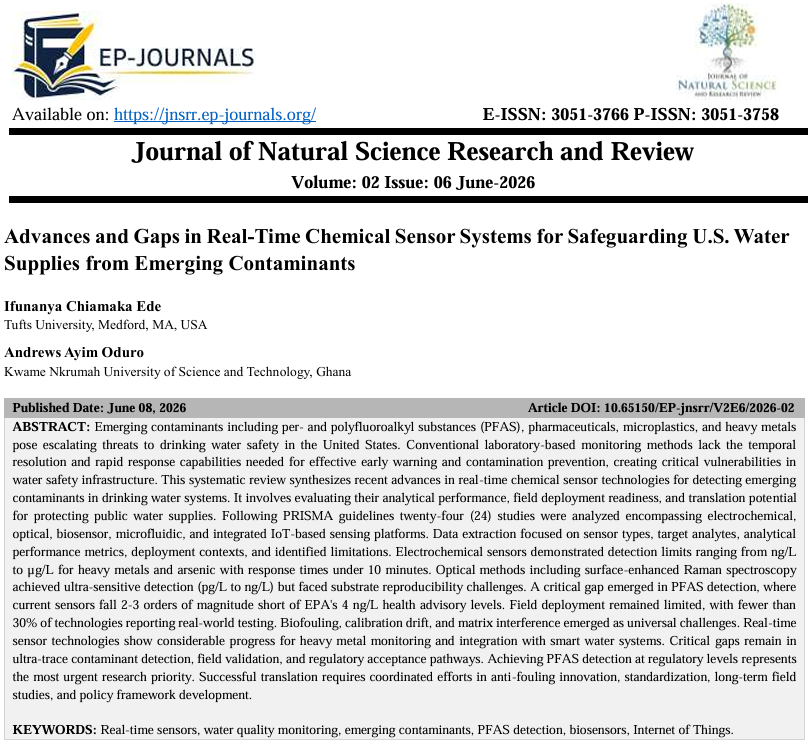
Emerging contaminants including per- and polyfluoroalkyl substances (PFAS), pharmaceuticals, microplastics, and heavy metals pose escalating threats to drinking water safety in the United States. Conventional laboratory-based monitoring methods lack the temporal resolution and rapid response capabilities needed for effective early warning and contamination prevention, creating critical vulnerabilities in water safety infrastructure. This systematic review synthesizes recent advances in real-time chemical sensor technologies for detecting emerging contaminants in drinking water systems. It involves evaluating their analytical performance, field deployment readiness, and translation potential for protecting public water supplies. Following PRISMA guidelines twenty-four (24) studies were analyzed encompassing electrochemical, optical, biosensor, microfluidic, and integrated IoT-based sensing platforms. Data extraction focused on sensor types, target analytes, analytical performance metrics, deployment contexts, and identified limitations. Electrochemical sensors demonstrated detection limits ranging from ng/L to µg/L for heavy metals and arsenic with response times under 10 minutes. Optical methods including surface-enhanced Raman spectroscopy achieved ultra-sensitive detection (pg/L to ng/L) but faced substrate reproducibility challenges. A critical gap emerged in PFAS detection, where current sensors fall 2-3 orders of magnitude short of EPA's 4 ng/L health advisory levels. Field deployment remained limited, with fewer than 30% of technologies reporting real-world testing. Biofouling, calibration drift, and matrix interference emerged as universal challenges. Real-time sensor technologies show considerable progress for heavy metal monitoring and integration with smart water systems. Critical gaps remain in ultra-trace contaminant detection, field validation, and regulatory acceptance pathways. Achieving PFAS detection at regulatory levels represents the most urgent research priority. Successful translation requires coordinated efforts in anti-fouling innovation, standardization, long-term field studies, and policy framework development.
References
1) Alavi-Borazjani, S. A., & Shafique, M. N. (2025). Chemical sensors for hazardous substances: advances in design, materials, and applications in environmental monitoring. Environmental Monitoring and Assessment, 198(1).
https://doi.org/10.1007/s10661-025-14838-1
2) Ferrão, T., & Sahu, P. P. (2025). Emerging Trends in Methods for Arsenic Detection in Drinking Water. Groundwater Monitoring & Remediation, 46(1), 84–108. https://doi.org/10.1111/gwmr.70029
3) Simonetti, F., Brillarelli, S., Agostini, M., Mancini, M., Gioia, V., Murtas, S., & Migliorati, V. (2025). A review on the latest frontiers in water quality in the era of emerging contaminants: A focus on perfluoroalkyl compounds. Environmental Pollution, 381, 126402.
https://doi.org/10.1016/j.envpol.2025.126402
4) Rivera, P., Della Pelle, F., Stonyte, J., Martins Antunes de Melo, W. de C., Abouhagger, A., & Pauliukaite, R. (2025). Overcoming Challenges in Electrochemical Sensing: Toward Continuous Monitoring. ACS Sensors, 10(12), 9183–9202.
https://doi.org/10.1021/acssensors.5c02717
5) Singh, B., Bhat, A., Thenuwara, G., Ravi, K., Naik, A. S., O’Connor, C., & Tian, F. (2025). Hidden Threats in Water: The Global Rise of Emerging Contaminants. Pollutants, 5(4), 48. https://doi.org/10.3390/pollutants5040048
6) Anchidin-Norocel, L., Bosancu, A., Iatcu, O. C., Lobiuc, A., & Covasa, M. (2025). Real-Time Detection of Heavy Metals and Some Other Pollutants in Wastewater Using Chemical Sensors: A Strategy to Limit the Spread of Antibiotic-Resistant Bacteria. Chemosensors, 13(9), 352. https://doi.org/10.3390/chemosensors13090352
7) Zhang, Y., Li, J., Jiao, S., Li, Y., Zhou, Y., Zhang, X., Maryam, B., & Liu, X. (2024). Microfluidic sensors for the detection of emerging contaminants in water: A review. Science of The Total Environment, 929, 172734. https://doi.org/10.1016/j.scitotenv.2024.172734
8) Yeih, N. S. and Kaiser, F. " Public Health Risks Associated with Per- and Polyfluoroalkyl Substances in Drinking Water: Current Knowledge and Research Gaps." Sarcouncil Journal of Internal Medicine and Public Health 4.5 (2025): pp 35 51. DOI- https://doi.org/10.5281/zenodo.17247233
9) Robert, B., & Kalpathy, S. K. (2025). Future prospects, challenges and opportunities in detecting heavy metal ions in water. Journal of Water Process Engineering, 75, 107992. https://doi.org/10.1016/j.jwpe.2025.107992
10) Yeih, N. S., Ansah, R. S., Olorunfemi, O. E., and Oware, E. ―Evaluating the Neurodevelopmental Effects of Per- and Polyfluoroalkyl Substances Exposure in Children: a Review.‖ Sarcouncil journal of Medical sciences, 4.12 (2025): pp 46-58.
DOI-https://doi.org/10.5281/zenodo.17967996
11) Nofil, M., & Periasamy, V. (2025). Detecting Contaminants in Water; A Review on the Current and State-of-the-Art Technologies. Water, Air, & Soil Pollution, 237(6). https://doi.org/10.1007/s11270-025-08995-9
12) Diab, M. A., Hassan, W. H., Shah, M., El-Sabban, H. A., & Baek, K.-H. (2025). Multiplex sensing of chlorine species in water: challenges and future perspectives: A mini-review. Microchemical Journal, 218, 115491. https://doi.org/10.1016/j.microc.2025.115491
13) La Cognata, R., Piazza, S., & Freni, G. (2025). Pollutant Monitoring Solutions in Water and Sewerage Networks: A Scoping Review. Water, 17(10), 1423. https://doi.org/10.3390/w17101423
14) Bhat, A., Gupta, A. K., O’Connor, C., Tian, F., & Singh, B. (2025). Emergence of Electroanalytical Techniques for Arsenic Detection in Water: Recent Trends and Future Perspectives. ChemElectroChem, 12(23). https://doi.org/10.1002/celc.202500259
15) Roy, A., Jk, N., Italiya, G., & Subramanian, S. (2025). Emerging contaminants jeopardizing groundwater integrity: environmental implications. Environmental Pollutants and Bioavailability, 37(1). https://doi.org/10.1080/26395940.2025.2572634
16) Fdez-Sanromán, A., Bernárdez-Rodas, N., Rosales, E., Pazos, M., González-Romero, E., & Sanromán, M. Á. (2025). Biosensor Technologies for Water Quality: Detection of Emerging Contaminants and Pathogens. Biosensors, 15(3), 189.
https://doi.org/10.3390/bios15030189
17) Asantewaa Adjei-Sah, O. and Oduro, A.A., (2025). Systematic Assessment of Analytical Techniques for The Trace-Level Detection of Per- And Polyfluoroalkyl Substances (Pfas) In Complex Environmental and Biological Matrices. EPRA International Journal of Research and Development, 10, pp. 376-387. https://doi.org/10.36713/epra25052
18) Mukendi, M. D., Salami, O. S., & Mketo, N. (2025). An In-Depth Review of Molecularly Imprinted Electrochemical Sensors as an Innovative Analytical Tool in Water Quality Monitoring: Architecture, Principles, Fabrication, and Applications. Micromachines, 16(3), 251. https://doi.org/10.3390/mi16030251
19) Adebayo, A. I., Olubanjo, K. T., Fadeke, A. M., Uyanah, J. J., Zirra, A. T., Igbaoreto, W. A., & Fakoyede, P. D. (2025). From static sampling to dynamic insights: The future of water quality monitoring with sensors, IOT, and drones. Science World Journal, 20(1), 454–
466. https://doi.org/10.4314/swj.v20i1.61
20) Rubaba, O., & Walingo, T. (2025). Advancing Water Quality Monitoring in eThekwini, South Africa: Integrating Water 4.0, Automation, and AI for Real-Time Surveillance. Water, 17(22), 3299. https://doi.org/10.3390/w17223299
21) Levin, R., Villanueva, C. M., Beene, D., Cradock, A. L., Donat-Vargas, C., Lewis, J., Martinez-Morata, I., Minovi, D., Nigra, A. E., Olson, E. D., Schaider, L. A., Ward, M. H., & Deziel, N. C. (2023). US drinking water quality: exposure risk profiles for seven legacy and emerging contaminants. Journal of Exposure Science & Environmental Epidemiology, 34(1), 3–22.
https://doi.org/10.1038/s41370-023-00597-z
22) Kalambate, P. K., Mane, S., Upadhyay, S. S., Kalambate, R. P., Gadhari, N. S., Sivasurya, E., Ashamary, F., Dar, M. A., Khosropour, H., & Manoj, D. (2026). Advances in electrochemical sensors for monitoring of emerging soil contaminants: Innovations, challenges, and environmental impact. TrAC Trends in Analytical Chemistry, 194, 118503. https://doi.org/10.1016/j.trac.2025.118503
23) Chen, P., Wang, J., Xue, Y., Wang, C., Sun, W., Yu, J., & Guo, H. (2024). From challenge to opportunity: Revolutionizing the monitoring of emerging contaminants in water with advanced sensors. Water Research, 265, 122297. https://doi.org/10.1016/j.watres.2024.122297
24) Goyal, A. K., & Nigam, A. (2025). Sensors for toxic metal ion detection in aquatic environment: current status and future perspectives. Discover Applied Sciences, 7(12). https://doi.org/10.1007/s42452-025-07936-9
Downloads
Published
Issue
Section
License
Copyright (c) 2026 Ifunanya Chiamaka Ede , Andrews Ayim Oduro (Author)

This work is licensed under a Creative Commons Attribution 4.0 International License.