The Impact of Clean Label Products on Fruit Juice Safety and Quality
DOI:
https://doi.org/10.65150/EP-jnsrr/V2E7/2026-01Keywords:
clean label, fruit juice, apple juice, peach juice, natural preservatives, food safety.Abstract
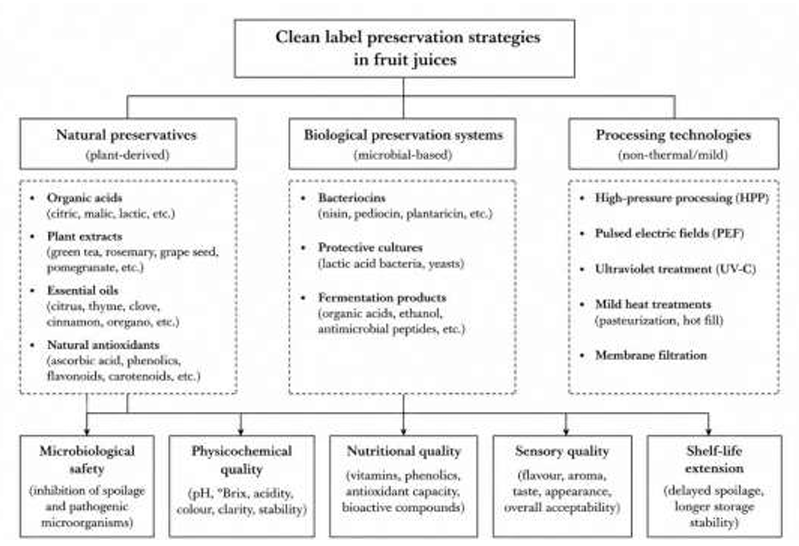
The growing demand for foods with simple ingredient lists has increased interest in clean label preservation strategies across the fruit juice industry. Apple (Malus domestica) and peach (Prunus persica) juices are widely appreciated for their nutritional value and sensory properties; however, maintaining their safety and quality during processing and storage remains a major challenge. This study examines the scientific literature concerning the use of clean label preservation approaches in fruit juices, with particular attention to their influence on microbiological safety, physicochemical characteristics, nutritional value, sensory quality, and shelf-life. The available evidence indicates that organic acids, plant extracts, essential oils, natural antioxidants, and fermentation-derived antimicrobial compounds can contribute to microbial control while helping preserve key quality attributes. Their effectiveness, however, depends on factors such as fruit composition, processing conditions, storage environment, and the selected preservation strategy. The literature also shows that combining natural preservatives with non-thermal technologies, including high-pressure processing and pulsed electric fields, provides additional opportunities to improve product stability while reducing the use of synthetic additives. Although further research is required to optimize these preservation systems for commercial applications, clean label approaches represent a promising direction for producing fruit juices that meet current consumer expectations without compromising safety or quality.
References
1) Asioli, D., Aschemann-Witzel, J., Caputo, V., Vecchio, R., Annunziata, A., Næs, T., & Varela, P. (2017). Making sense of the 'clean label' trends: A review of consumer food choice behavior and discussion of industry implications. Food Research International, 99, 58–71. https://doi.org/10.1016/j.foodres.2017.07.022
2) Burt, S. A. (2004). Essential oils: Their antibacterial properties and potential applications in foods—A review. International Journal of Food Microbiology, 94(3), 223–253. https://doi.org/10.1016/j.ijfoodmicro.2004.03.022
3) Cleveland, J., Montville, T. J., Nes, I. F., & Chikindas, M. L. (2001). Bacteriocins: Safe, natural antimicrobials for food preservation. International Journal of Food Microbiology, 71(1), 1–20. https://doi.org/10.1016/S0168-1605(01)00560-8
4) Davidson, P. M., Sofos, J. N., & Branen, A. L. (Eds.). (2013). Antimicrobials in Food (4th ed.). CRC Press.
5) Jay, J. M., Loessner, M. J., & Golden, D. A. (2005). Modern Food Microbiology (7th ed.). Springer.
6) Rawson, A., Patras, A., Tiwari, B. K., Noci, F., Koutchma, T., & Brunton, N. P. (2011). Effect of thermal and non-thermal processing technologies on the bioactive content of fruit and vegetable products. Critical Reviews in Food Science and Nutrition, 51(6), 571–590. https://doi.org/10.3109/10408391003748144
7) Román, S., Sánchez-Siles, L. M., & Siegrist, M. (2017). The importance of food naturalness for consumers: Results of a systematic review. Trends in Food Science & Technology, 67, 44–57. https://doi.org/10.1016/j.tifs.2017.06.010
8) Settanni, L., & Corsetti, A. (2008). Application of bacteriocins in vegetable food biopreservation. International Journal of Food Microbiology, 121(2), 123–138. https://doi.org/10.1016/j.ijfoodmicro.2007.08.001
9) Choi, Y., et al. (2024). Clean-label antimicrobial strategies in foods: Current applications and future perspectives. Comprehensive Reviews in Food Science and Food Safety. [Verify full bibliographic details before submission.]
10) Lisboa, H., et al. (2024). Innovative and sustainable food preservation techniques: Advances, challenges and future perspectives. Sustainability, 16, 8223. [Verify full bibliographic details before submission.]
Downloads
Published
Issue
Section
License
Copyright (c) 2026 Diellon Salihaj, Dzulijana Tomovska (Author)

This work is licensed under a Creative Commons Attribution 4.0 International License.