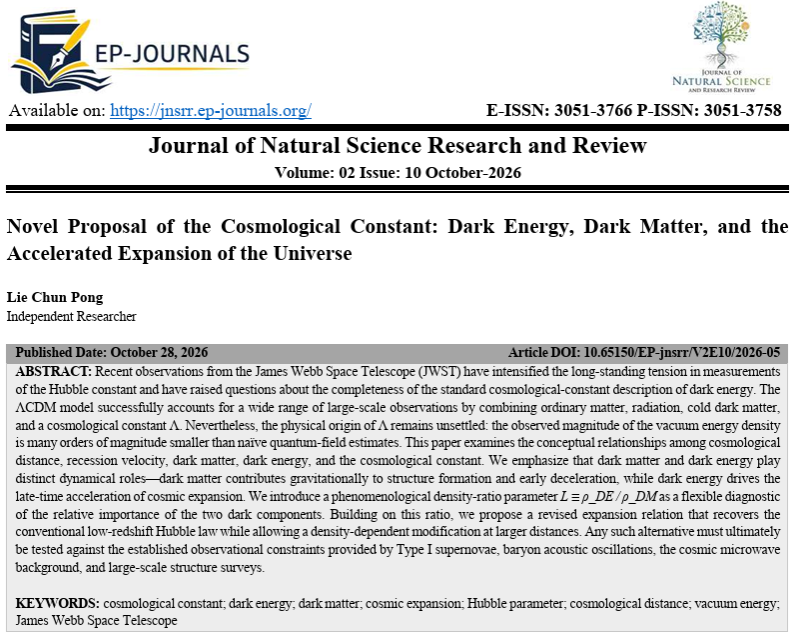
Novel Proposal of the Cosmological Constant: Dark Energy, Dark Matter, and the Accelerated Expansion of the Universe
DOI:
https://doi.org/10.65150/EP-jnsrr/V2E10/2026-05Keywords:
cosmological constant, dark energy, dark matter, cosmic expansion, Hubble parameter, cosmological distance, vacuum energy, James Webb Space TelescopeAbstract
Recent observations from the James Webb Space Telescope (JWST) have intensified the long-standing tension in measurements of the Hubble constant and have raised questions about the completeness of the standard cosmological-constant description of dark energy. The ΛCDM model successfully accounts for a wide range of large-scale observations by combining ordinary matter, radiation, cold dark matter, and a cosmological constant Λ. Nevertheless, the physical origin of Λ remains unsettled: the observed magnitude of the vacuum energy density is many orders of magnitude smaller than naïve quantum-field estimates. This paper examines the conceptual relationships among cosmological distance, recession velocity, dark matter, dark energy, and the cosmological constant. We emphasize that dark matter and dark energy play distinct dynamical roles—dark matter contributes gravitationally to structure formation and early deceleration, while dark energy drives the late-time acceleration of cosmic expansion. We introduce a phenomenological density-ratio parameter L ≡ ρ_DE / ρ_DM as a flexible diagnostic of the relative importance of the two dark components. Building on this ratio, we propose a revised expansion relation that recovers the conventional low-redshift Hubble law while allowing a density-dependent modification at larger distances. Any such alternative must ultimately be tested against the established observational constraints provided by Type I supernovae, baryon acoustic oscillations, the cosmic microwave background, and large-scale structure surveys.
References
1) Planck Collaboration, “Planck 2018 results. VI. Cosmological parameters,” Astron. Astrophys. 641, A6 (2020).
2) A. G. Riess et al., “A Comprehensive Measurement of the Local Value of the Hubble Constant with 1 km s⁻¹ Mpc⁻¹ Uncertainty from the Hubble Space Telescope and the SH0ES Team,” Astrophys. J. Lett. 934, L7 (2022).
3) S. Perlmutter et al., “Measurements of Ω and Λ from 42 High-Redshift Supernovae,” Astrophys. J. 517, 565 (1999).
4) A. G. Riess et al., “Observational Evidence from Supernovae for an Accelerating Universe and a Cosmological Constant,” Astron. J. 116, 1009 (1998).
5) James Webb Space Telescope Early Release Science and Cycle 1 high-redshift galaxy programs (various authors, 2022–2025).
6) E. Di Valentino et al., “In the realm of the Hubble tension—a review of solutions,” Class. Quantum Grav. 38, 153001 (2021).
Downloads
Published
Issue
Section
License
Copyright (c) 2026 Lie Chun Pong (Author)

This work is licensed under a Creative Commons Attribution 4.0 International License.