E-Waste and Emerging Waste Streams (E-Cigarettes, Gas Cylinders): A Systematic Review of Global Management Strategies and Implications for U.S. Stewardship Programs
DOI:
https://doi.org/10.65150/EP-jnsrr/V2E6/2026-05Keywords:
e‑waste, e‑cigarettes, hydrometallurgy, pyrometallurgyAbstract
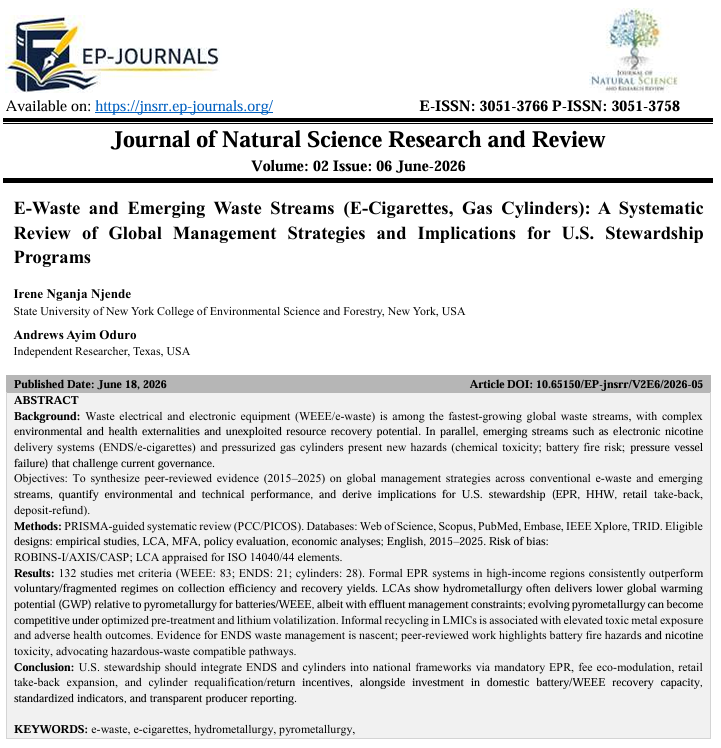
Background: Waste electrical and electronic equipment (WEEE/e‑waste) is among the fastest‑growing global waste streams, with complex environmental and health externalities and unexploited resource recovery potential. In parallel, emerging streams such as electronic nicotine delivery systems (ENDS/e‑cigarettes) and pressurized gas cylinders present new hazards (chemical toxicity; battery fire risk; pressure vessel failure) that challenge current governance.
Objectives: To synthesize peer‑reviewed evidence (2015–2025) on global management strategies across conventional e‑waste and emerging streams, quantify environmental and technical performance, and derive implications for U.S. stewardship (EPR, HHW, retail take‑back, deposit‑refund).
Methods: PRISMA‑guided systematic review (PCC/PICOS). Databases: Web of Science, Scopus, PubMed, Embase, IEEE Xplore, TRID. Eligible designs: empirical studies, LCA, MFA, policy evaluation, economic analyses; English, 2015–2025. Risk of bias:
ROBINS‑I/AXIS/CASP; LCA appraised for ISO 14040/44 elements.
Results: 132 studies met criteria (WEEE: 83; ENDS: 21; cylinders: 28). Formal EPR systems in high‑income regions consistently outperform voluntary/fragmented regimes on collection efficiency and recovery yields. LCAs show hydrometallurgy often delivers lower global warming potential (GWP) relative to pyrometallurgy for batteries/WEEE, albeit with effluent management constraints; evolving pyrometallurgy can become competitive under optimized pre‑treatment and lithium volatilization. Informal recycling in LMICs is associated with elevated toxic metal exposure and adverse health outcomes. Evidence for ENDS waste management is nascent; peer‑reviewed work highlights battery fire hazards and nicotine toxicity, advocating hazardous‑waste compatible pathways.
Conclusion: U.S. stewardship should integrate ENDS and cylinders into national frameworks via mandatory EPR, fee eco‑modulation, retail take‑back expansion, and cylinder requalification/return incentives, alongside investment in domestic battery/WEEE recovery capacity, standardized indicators, and transparent producer reporting.
References
1) Ahirwar, R., & Tripathi, A. K. (2021). E-waste management: A review of recycling process, environmental and occupational health hazards, and potential solutions. Environmental Nanotechnology, Monitoring & Management, 15, 100409.
2) Amorin, R., & Dabo, K. (2022). Assessment of the Safety Handling of Domestic Liquified Petroleum Gas (LPG) cylinders using a suburb of afienya township as a case study. European Journal of Technology, 6(2), 16-31.
3) Backes, J. G., Hinkle-Johnson, R., & Traverso, M. (2023). The influence of the Functional Unit on the comparability of life cycle assessments in the construction sector: A Systematic Literature Review and attempt at unification for Reinforced Concrete. Case Studies in Construction Materials, 18, e01966.
4) Bakare¹, S. S., Adeniyi, A. O., Akpuokwe, C. U., & Eneh⁴, N. E. (2024). Data privacy laws and compliance: a comparative review of the EU GDPR and USA regulations.
5) Castellani, P. (2025). Empowering Development. Strategies and Projects for Sustainable Waste Management in the Majority World.
6) Donovan, E. M., Azadi, M., McKay, T., Aarvig, K., & Kreslake, J. (2025). Not‐so‐disposable e‐cigarettes: Methods young people use to discard single‐use e‐cigarettes. Addiction, 120(3), 452-457.
7) Eaton, D. L., Kwan, L. Y., Stratton, K., National Academies of Sciences, Engineering, and Medicine, & Committee on the Review of the Health Effects of Electronic Nicotine Delivery Systems. (2018). Toxicology of E-cigarette constituents. In Public health consequences of E-cigarettes. National Academies Press (US).
8) Faibil, D., Asante, R., Agyemang, M., Addaney, M., & Baah, C. (2023). Extended producer responsibility in developing economies: Assessment of promoting factors through retail electronic firms for sustainable e-waste management. Waste Management & Research, 41(1), 117-142.
9) Hickle, G. T. (2013). Comparative analysis of extended producer responsibility policy in the United States and Canada. Journal of Industrial Ecology, 17(2), 249-261.
10) Hong, J., Shi, W., Wang, Y., Chen, W., & Li, X. (2015). Life cycle assessment of electronic waste treatment. Waste Management, 38, 357-365.
11) Marra, Alessandra, Alessandra Cesaro, and Vincenzo Belgiorno. "Separation efficiency of valuable and critical metals in WEEE mechanical treatments." Journal of Cleaner Production 186 (2018): 490-498.
12) Nguyen, T., Van Nguyen, T., Zhou, L., Duong, Q. H., & Ieromonachou, P. (2025). Assessing the impact of EU policies on recycling supply chain: a system dynamics perspective on advancing packaging recycling capacity. Annals of Operations Research, 1-53.
13) Page, M. J., McKenzie, J. E., Bossuyt, P. M., Boutron, I., Hoffmann, T. C., Mulrow, C. D., ... & Moher, D. (2021). The PRISMA 2020 statement: an updated guideline for reporting systematic reviews. bmj, 372.
14) Palluzi, R. (2009). Compressed gases: Managing cylinders safely. Chemical Engineering, 116(10), 52.
15) Quackenbush, C. S. (2025). E-Cigarettes as Waste and the Need to Regulate" Disposable" Products. Env't L. Rep., 55, 10219.
16) UNITAR. (2024, March 20). Global E-waste Monitor 2024: Electronic waste rising five times faster than documented e-waste recycling. United Nations Institute for Training and Research. https://unitar.org/about/news-stories/press/global-e-waste-monitor-2024-electronic-waste-rising-five-times-faster-documented-e-waste-recycling
17) Vishwakarma, A., Kanaujia, K., & Hait, S. (2023). Global scenario of E-waste generation: trends and future predictions. In Global e-waste management strategies and future implications (pp. 13-30). Elsevier.
18) Ward, A. M., Yaman, R., & Ebbert, J. O. (2020). Electronic nicotine delivery system design and aerosol toxicants: A systematic review. PloS one, 15(6), e0234189.
19) Ward, A. M., Yaman, R., & Ebbert, J. O. (2020). Electronic nicotine delivery system design and aerosol toxicants: A systematic review. PloS one, 15(6), e0234189.
20) World Health Organization. (2016). Electronic nicotine delivery systems and electronic non-nicotine delivery systems (ENDS/ENNDS).
21) Ylä-Mella, J., Poikela, K., Lehtinen, U., Tanskanen, P., Román, E., Keiski, R. L., & Pongrácz, E. (2014). Overview of the WEEE Directive and its implementation in the Nordic countries: national realisations and best practices. Journal of Waste Management, 2014(1), 457372.
Downloads
Published
Issue
Section
License
Copyright (c) 2026 Irene Nganja Njende , Andrews Ayim Oduro (Author)

This work is licensed under a Creative Commons Attribution 4.0 International License.