Optimizing Growth Dynamics and Vase Life Extension of Daffodil (Narcissus Tazetta L. Var. Orientalis 'Double Roman') Through High-Dose Compost and GA₃ Pre-Treatment
DOI:
https://doi.org/10.65150/EP-jnsrr/V2E10/2026-03Keywords:
Narcissus tazetta var. Orientalis, Phyto-priming, Gibberellic acid (GA₃), Flowering longevity, Vegetative architecture, and Compost made from Palm fronds.Abstract
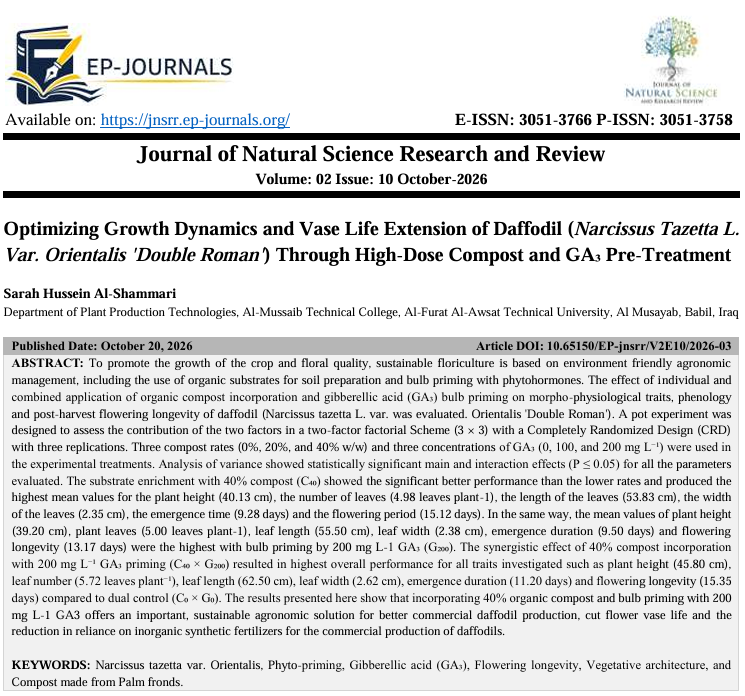
To promote the growth of the crop and floral quality, sustainable floriculture is based on environment friendly agronomic management, including the use of organic substrates for soil preparation and bulb priming with phytohormones. The effect of individual and combined application of organic compost incorporation and gibberellic acid (GA₃) bulb priming on morpho-physiological traits, phenology and post-harvest flowering longevity of daffodil (Narcissus tazetta L. var. was evaluated. Orientalis 'Double Roman'). A pot experiment was designed to assess the contribution of the two factors in a two-factor factorial Scheme (3 × 3) with a Completely Randomized Design (CRD) with three replications. Three compost rates (0%, 20%, and 40% w/w) and three concentrations of GA₃ (0, 100, and 200 mg L⁻¹) were used in the experimental treatments. Analysis of variance showed statistically significant main and interaction effects (P ≤ 0.05) for all the parameters evaluated. The substrate enrichment with 40% compost (C₄₀) showed the significant better performance than the lower rates and produced the highest mean values for the plant height (40.13 cm), the number of leaves (4.98 leaves plant-1), the length of the leaves (53.83 cm), the width of the leaves (2.35 cm), the emergence time (9.28 days) and the flowering period (15.12 days). In the same way, the mean values of plant height (39.20 cm), plant leaves (5.00 leaves plant-1), leaf length (55.50 cm), leaf width (2.38 cm), emergence duration (9.50 days) and flowering longevity (13.17 days) were the highest with bulb priming by 200 mg L-1 GA₃ (G₂₀₀). The synergistic effect of 40% compost incorporation with 200 mg L⁻¹ GA₃ priming (C₄₀ × G₂₀₀) resulted in highest overall performance for all traits investigated such as plant height (45.80 cm), leaf number (5.72 leaves plant⁻¹), leaf length (62.50 cm), leaf width (2.62 cm), emergence duration (11.20 days) and flowering longevity (15.35 days) compared to dual control (C₀ × G₀). The results presented here show that incorporating 40% organic compost and bulb priming with 200 mg L-1 GA3 offers an important, sustainable agronomic solution for better commercial daffodil production, cut flower vase life and the reduction in reliance on inorganic synthetic fertilizers for the commercial production of daffodils.
References
1) Abood, K. H., Hussein, H. A., & Al-Shammari, S. H. S. (2026). Influence of Compost Fertilizer and Gibberellic Acid Priming of Bulbs on the Growth and Flowering of Daffodil (Narcissus tazetta L.) Plants. European Journal of Ecology, Biology and Agriculture, 3(3). https://doi.org/10.59324/ejeba.2026.3(3).27
2) Adebayo, I. A., Pam, V. K., Arsad, H., and Samian, M. R. (2020). The global floriculture industry: Status and future prospects. In H. K. Rehman (Ed.), The global floriculture industry: Shifting directions, new trends, and future prospects (pp. 1–14). Apple Academic Press. https://doi.org/10.1201/9781003000723-1
3) Adedayo, A. A., Babalola, O. O., Prigent-Combaret, C., Cruz, C., Stefan, M., Kutu, F. R., and Glick, B. R. (2022). The application of plant growth-promoting rhizobacteria in Solanum lycopersicum production in the agricultural system: A review. PeerJ, 10, Article e13405. https://doi.org/10.7717/peerj.13405
4) Agudelo-Morales, C. E., Lerma, T. A., Martínez, J. M., Palencia, M., and Combatt, E. M. (2021). Phytohormones and plant growth regulators: A review. Journal of Science with Technological Applications, 10, 27–65. https://doi.org/10.34294/j.jsta.21.10.66
5) Ahmed, M. S., Sadiq, Q. S., and Issa, F. H. (2009). Effect of soil mulching and organic fertilizers on N, P and K concentrations and potato yield growth in integrated farming systems. Iraqi Journal of Agricultural Sciences, 14(2), 53–64.
6) Al-Khafaji, M. A. (2014). Plant growth regulators, their horticultural applications and uses. University House for Printing, Publishing and Translation.
7) Al-Sahuki, M., and Waheeb, K. M. (1990). Applications in the design and analysis of experiments. House of Wisdom for Printing and Publishing.
8) Asami, T., and Nakagawa, Y. (2018). Preface to the special issue: Brief review of plant hormones and their utilization in agriculture. Journal of Pesticide Science, 43(3), 154–158. https://doi.org/10.1584/jpestics.M18-02
9) Asif, L., Tehami, S., Qadeer, Y. K., Virani, S. S., Lavie, C. J., and Krittanawong, C. (2025). Toxic grounds: A narrative review of the role of heavy metal soil and water contamination in cardiovascular disease development. Heart and Mind. Advance online publication. https://doi.org/10.4103/hm.HM-D-24-00108
10) Bamdad, H., Papari, S., Lazarovits, G., and Berruti, F. (2022). Soil amendments for sustainable agriculture: Microbial organic fertilizers. Soil Use and Management, 38(1), 94–120. https://doi.org/10.1111/sum.12762
11) Boshra, Y. R., Fahim, J. R., Hamed, A. N. E., and Desoukey, S. Y. (2022). Phytochemical and biological attributes of Narcissus pseudonarcissus L. (Amaryllidaceae): A review. South African Journal of Botany, 146, 437–458.
https://doi.org/10.1016/j.sajb.2021.11.028
12) Brahimi, A. A. K. (2011). Effect of organic residues type, boron spraying and glycated solution on pepper growth and yield (Capsicum annuum L.) cultivated in greenhouses (Master's thesis). University of Kufa.
13) Breiterová, K., Koutová, D., Maříková, J., Havelek, R., Kuneš, J., Majorošová, M., Opletal, L., Hošťálková, A., Jenčo, J., Řezáčová, M., and Cahlíková, L. (2020). Amaryllidaceae alkaloids of different structural types from Narcissus L. cv. Professor Einstein and their cytotoxic activity. Plants, 9(2), Article 137. https://doi.org/10.3390/plants9020137
14) Chaudhari, S., Upadhyay, A., and Kulshreshtha, S. (2021). Influence of organic amendments on soil properties, microflora and plant growth. In E. Lichtfouse (Ed.), Sustainable Agriculture Reviews (Vol. 52, pp. 147–191). Springer. https://doi.org/10.1007/978-3-030-73245-5_5
15) El-Attar, A. B., Othman, E. Z., El-Bahbohy, R. M., and Mahmoud, A. W. M. (2023). Efficiency of different potassium sources and soil bio-fertilizers for growth, productivity, and biochemical constituents of narcissus (Narcissus tazetta L.). Journal of Plant Nutrition, 46(10), 2416–2433. https://doi.org/10.1080/01904167.2022.2155552
16) Farman, S., Mushtaq, A., and Azeem, M. W. (2019). Plant growth regulators (PGRs) and their applications: A review. International Journal of Chemical and Biochemical Sciences, 15, 94–103.
17) Faust, J. E., and Dole, J. M. (2021). The global cut flower and foliage marketplace. In Cut Flowers and Foliages (pp. 1–47). CABI.
18) Groom, N. (2012). The perfume handbook. Springer. https://doi.org/10.1007/978-94-011-2324-8
19) Hassan, F. A. E. S. (2005). Postharvest studies on some important flower crops (Doctoral dissertation). Corvinus University of Budapest.
20) Hou, M., Wu, D., Li, Y., Tao, W., Chao, L., and Zhang, Y. (2021). The role of auxin in nitrogen-modulated shoot branching. Plant Signaling and Behavior, 16(4), Article 1885888. https://doi.org/10.1080/15592324.2021.1885888
21) Hurrell, J. A. (2016). Ornamental plants. In Introduction to Ethnobiology (pp. 171–176). Springer. https://doi.org/10.1007/978-3-319-28155-1_25
22) Ibrahim, A. I., Batlle, E., Sneha, S., Jiménez, R., Pequerul, R., Parés, X., Rüngeler, T., Jha, V., Tuccinardi, T., Sadiq, M., Frame, F., Maitland, N. J., Farrés, J., and Pors, K. K. (2022). Expansion of the 4-(diethylamino)benzaldehyde scaffold to explore the impact on aldehyde dehydrogenase activity and antiproliferative activity in prostate cancer. Journal of Medicinal Chemistry, 65(5), 3833–3848. https://doi.org/10.1021/acs.jmedchem.1c01367
23) Jokar, N. K., and Hassanpour Asil, M. H. (2021). Effect of gibberellic acid and vermicompost on growth and flowering characteristics of daffodil flower (Narcissus tazetta L.). Journal of Crops Improvement, 23(1), 183–198. https://doi.org/10.22059/jci.2020.296530.2341
24) Jote, C. A. (2023). The impacts of using inorganic chemical fertilizers on the environment and human health. Organic and Medicinal Chemistry International Journal, 13(3), Article 555864. https://doi.org/10.19080/OMCIJ.2023.13.555864
25) Kesarwani, A., Pramanick, B., Chowdhury, A. R., Rani, M., Kumar, R., Jayara, A. S., and Saini, R. K. (2024). Nitrate toxicity and health hazards: Problems and mitigation challenges. CABI Reviews, 19(1). https://doi.org/10.1079/cabireviews.2024.005
26) Kosakivska, I. V., and Vasyuk, V. A. (2021). Gibberellins in regulation of plant growth and development under abiotic stresses. Biotechnologia Acta, 14(2), 5–18. https://doi.org/10.15407/biotech14.02.005
27) Kurve, G., Vidhya Shankar, M., Kumar, A., and Singh, O. P. (2018). Effect of pre-soaking of bulbs in plant growth regulators on flowering and vase life of tuberose (Polianthes tuberosa Linn.). International Journal of Chemical Studies, 6, 1485–1490.
28) Lee, K. P., and Elston, D. M. (2023). Botanical briefs: Daffodils (Narcissus species). Cutis, 111(1), 41–45.
https://doi.org/10.12788/cutis.0678
29) Liu, Y., and Liao, W. (2025). Ornamental crops: An introduction to bulbous flowers. In Breeding of Ornamental Crops: Bulbous Flowers (pp. 1–38). Springer. https://doi.org/10.1007/978-3-031-77900-8_1
30) Lupepsa, B. F., Ferrarese-Filho, O., Constantin, R. P., Marchiosi, R., and dos Santos, W. D. (2024). Gibberellin biosynthesis, its roles in plant physiology and abiotic stress responses. Brazilian Journal of Development, 10(11), Article e74232.
https://doi.org/10.34117/bjdv10n11-003
31) Maryam, S., and Gul, A. (2025). Recent developments in Narcissus species breeding, genomic analysis, biochemistry. In Breeding of Ornamental Crops: Bulbous Flowers (pp. 605–635). Springer. https://doi.org/10.1007/978-3-031-77900-8_17
32) Mazumder, K., Biswas, B., Raja, I. M., and Fukase, K. (2020). A review of cytotoxic plants of the Indian subcontinent and a broad-spectrum analysis of their bioactive compounds. Molecules, 25(8), Article 1904. https://doi.org/10.3390/molecules25081904
33) Mooleki, S. P., Schoenau, J. J., Charles, J. L., and Wen, G. (2004). Effect of rate, frequency and incorporation of feedlot cattle manure on soil nitrogen availability, crop performance and nitrogen use efficiency in east-central Saskatchewan. Canadian Journal of Soil Science, 84(2), 199–210. https://doi.org/10.4141/S02-045
34) Muniandi, S. K. M., Hossain, M. A., Abdullah, M. P., and Ab Shukor, N. A. (2018). Gibberellic acid (GA₃) affects growth and development of some selected kenaf (Hibiscus cannabinus L.) cultivars. Industrial Crops and Products, 118, 180–187.
https://doi.org/10.1016/j.indcrop.2018.03.036
35) Nasir, M. H. (2017). Influence of different organic manures and bio-fertilisers on morphological, floral and bulb traits of narcissus (daffodil cv. “Salome”). International Journal of Agricultural Sciences, 13, 1–5.
36) Shah, S. H., Islam, S., Mohammad, F., and Siddiqui, M. H. (2023). Gibberellic acid: A versatile regulator of plant growth, development and stress responses. Journal of Plant Growth Regulation, 42(12), 7352–7373. https://doi.org/10.1007/s00344-023-11035
37) Situma, M. N., Mwangi, M., and Mulwa, R. M. (2015). Effects of benzyl adenine and gibberellic acid pre-treatments on dormancy release, flowering time and multiplication of oriental lily (Lilium longiflorum) bulbs. Journal of Applied Horticulture, 17(1), 26–30.
https://doi.org/10.37855/jah.2015.v17i01.06
38) Tagkas, C. F., Rizos, E. C., Markozannes, G., Karalexi, M. A., Wairegi, L., and Ntzani, E. E. (2024). Fertilizers and human health: A systematic review of the epidemiological evidence. Toxics, 12(10), Article 694. https://doi.org/10.3390/toxics12100694
39) Taiz, L., Zeiger, E., Møller, I. M., and Murphy, A. (2021). Plant physiology and development (7th ed.). Sinauer Associates/Oxford University Press.
40) Verma, S., Pradhan, S. S., Singh, A., and Kushuwaha, M. (2024). Effect of organic manure on different soil properties: A review. International Journal of Plant and Soil Science, 36(5), 182–187. https://doi.org/10.9734/ijpss/2024/v36i5451
Downloads
Published
Issue
Section
License
Copyright (c) 2026 Sarah Hussein Al-Shammari (Author)

This work is licensed under a Creative Commons Attribution 4.0 International License.