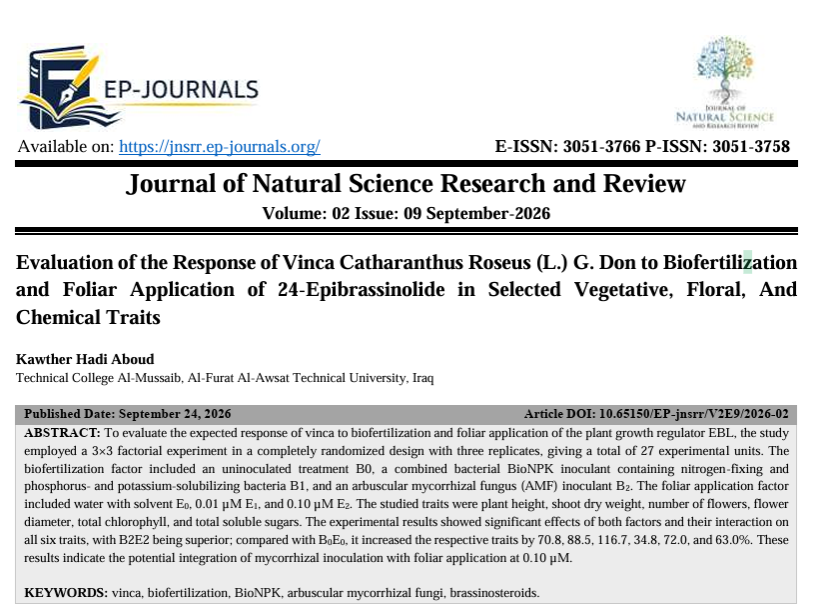
Evaluation of the Response of Vinca Catharanthus Roseus (L.) G. Don to Biofertilization and Foliar Application of 24-Epibrassinolide in Selected Vegetative, Floral, And Chemical Traits
DOI:
https://doi.org/10.65150/EP-jnsrr/V2E9/2026-02Keywords:
vinca, biofertilization, BioNPK, arbuscular mycorrhizal fungi, brassinosteroids.Abstract
To evaluate the expected response of vinca to biofertilization and foliar application of the plant growth regulator EBL, the study employed a 3×3 factorial experiment in a completely randomized design with three replicates, giving a total of 27 experimental units. The biofertilization factor included an uninoculated treatment B0, a combined bacterial BioNPK inoculant containing nitrogen-fixing and phosphorus- and potassium-solubilizing bacteria B1, and an arbuscular mycorrhizal fungus (AMF) inoculant B2. The foliar application factor included water with solvent E0, 0.01 µM E1, and 0.10 µM E2. The studied traits were plant height, shoot dry weight, number of flowers, flower diameter, total chlorophyll, and total soluble sugars. The experimental results showed significant effects of both factors and their interaction on all six traits, with B2E2 being superior; compared with B0E0, it increased the respective traits by 70.8, 88.5, 116.7, 34.8, 72.0, and 63.0%. These results indicate the potential integration of mycorrhizal inoculation with foliar application at 0.10 µM.
References
1) Alam, M. M., Naeem, M., & Khan, M. M. A. (2016). Exploiting the epibrassinolide as a plant growth promoter for augmenting the growth, physiological activities and alkaloids production in Catharanthus roseus L. Journal of Medicinal Plants Studies, 4(4), 88–93. https://www.plantsjournal.com/archives/2016/vol4issue4/PartB/4-3-35-172.pdf
2) De la Rosa-Mera, C., Ferrera-Cerrato, R., Alarcón, A., Sánchez-Colín, M. de J., & Franco-Ramírez, A. (2012). Isolation of arbuscular mycorrhizal fungi consortia from medicinal plants and their effectiveness on growth of vinca (Catharanthus roseus). Revista Chilena de Historia Natural, 85(2), 187–198. https://doi.org/10.4067/S0716-078X2012000200005
3) Doran, L., & De Souza, A. P. (2021). Total soluble sugar quantification from ethanolic plant extracts. protocols.io.
https://doi.org/10.17504/protocols.io.b2nsqdee
4) Gao, X., Zhu, X., Wang, Z., Liu, X., Guo, R., Luan, J., Liu, Z., & Yu, F. (2025). Modulation of terpenoid indole alkaloid biosynthesis in Catharanthus roseus by Sphingomonas sp. Y503 via the CrMAPKKK1–CrMAPKK1/CrMAPKK2–CrMPK3 signaling cascade. Plant, Cell & Environment, 48(2), 1692–1704. https://doi.org/10.1111/pce.15253
5) Huang, G., Han, M., Yao, W., & Wang, Y. (2017). Transcriptome analysis reveals the regulation of brassinosteroids on petal growth in Gerbera hybrida. PeerJ, 5, e3382. https://doi.org/10.7717/peerj.3382
6) Liu, Y., Qi, Z., Wei, J., Yu, J., & Xia, X. (2022). Brassinosteroids promote starch synthesis and the implication in low-light stress tolerance in Solanum lycopersicum. Environmental and Experimental Botany, 201, 104990.
https://doi.org/10.1016/j.envexpbot.2022.104990
7) Parrey, Z. A., Shah, S. H., Mohammad, F., Siddiqui, M. H., Alamri, S., & Kalaji, H. M. (2023). Exogenous epibrassinolide application improves essential oil biosynthesis and trichome development in peppermint via modulating growth and physicochemical processes. Scientific Reports, 13, 12924. https://doi.org/10.1038/s41598-023-40210-9
8) Quadri, A., Sambuco, B., Trenta, M., Tassinari, P., Torreggiani, D., Mercolini, L., Protti, M., Zambonelli, A., Puliga, F., & Barbaresi, A. (2026). Red light and biostimulants containing arbuscular mycorrhizal fungi enhance ajmalicine and serpentine production in Catharanthus roseus under indoor conditions. Scientific Reports, 16, 1102. https://doi.org/10.1038/s41598-025-30694-y
9) Sharma, P., Kaushal, S., & Baishya, R. (2023). Biofertilizers alleviate salinity stress in medicinally important plant—Catharanthus roseus (L.) G. Don by enhancing morphological and photosynthetic attributes. International Journal of Ecology and Environmental Sciences, 49(4), 387–397. https://doi.org/10.55863/ijees.2023.2742
10) Srinivasan, R., & Govindasamy, C. (2014). Influence of native arbuscular mycorrhizal fungi on growth, nutrition and phytochemical constituents of Catharanthus roseus (L.) G. Don. Journal of Coastal Life Medicine, 2(1), 31–37.
https://doi.org/10.12980/JCLM.2.2014C144
11) Surgun Acar, Y. (2020). The effect of 24-epibrassinolide treatments at different concentrations on some growth parameters and crocin level in saffron (Crocus sativus L.). International Journal of Secondary Metabolite, 7(2), 109–118. https://doi.org/10.21448/ijsm.699292
12) Thakur, R., & Yadav, S. (2025). Exopolysaccharides and biofilm forming microbial inoculant AB-13 acting in a consortium promotes growth of economically important medicinal plant Catharanthus roseus. International Journal of Biological Macromolecules, 319(Pt 1), 145122. https://doi.org/10.1016/j.ijbiomac.2025.145122
Downloads
Published
Issue
Section
License
Copyright (c) 2026 Kawther Hadi Aboud (Author)

This work is licensed under a Creative Commons Attribution 4.0 International License.