Soya, Sweat, And Sunlight: Predictors of Prostate Cancer Prevention Among Health Science Students
DOI:
https://doi.org/10.65150/EP-jnsrr/V2E4/2026-01Keywords:
Prostate cancer prevention, soya milk consumption, physical exercise, sunlight exposure, health promotion, prevention literacy, health science studentsAbstract
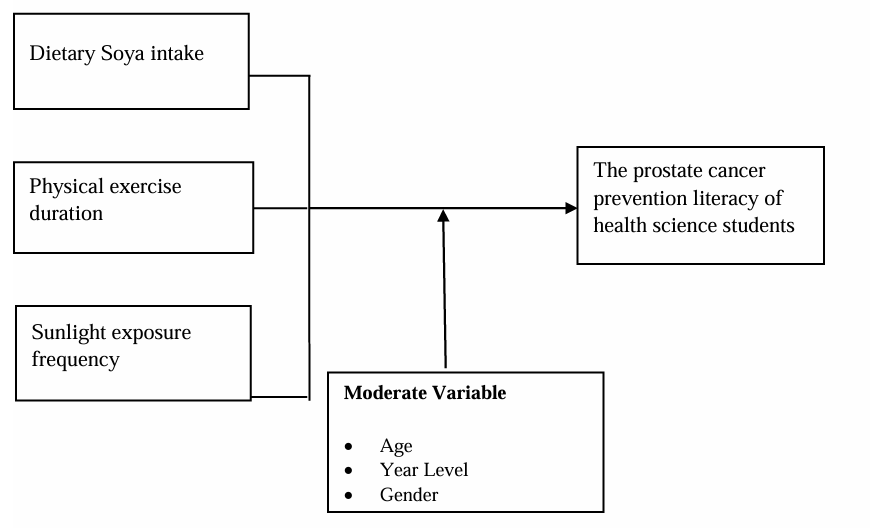
Background: Prostate cancer remains a major global health concern, with increasing evidence highlighting the role of modifiable lifestyle factors such as diet, physical activity, and sunlight exposure in its prevention. Despite growing awareness, limited research has explored how these factors influence prostate cancer prevention literacy among health science students in Rwanda. This study examined the predictive role of soya milk consumption, physical exercise, and sunlight exposure on prostate cancer knowledge and preventive behavior among students from selected institutions.
Methods: A quantitative, descriptive-correlational research design was employed involving 142 health science students selected through stratified random sampling from the University of Gitwe, East African Christian College, and Institut Catholique de Kabgayi (ICK). Data were collected using a self-structured 24-item questionnaire assessing lifestyle practices and prostate cancer prevention literacy. Descriptive statistics, Spearman’s rank-order correlation, and multiple regression analysis were used to analyze the data.
Findings: The results revealed moderate engagement in prostate cancer–preventive lifestyles, with composite means of 3.36 for soya milk consumption, 3.39 for physical exercise, and 3.31 for sunlight exposure. Significant positive correlations were found between lifestyle factors and prevention literacy, with sunlight exposure (ρ = 0.861), physical exercise (ρ = 0.787), and soya milk consumption (ρ = 0.723), all p < 0.001. Regression analysis indicated that sunlight exposure was the strongest predictor (β = 0.672, p < 0.001), followed by physical exercise (β = 0.172, p = 0.006) and soya milk consumption (β = 0.100, p = 0.045), explaining 76% of the variance.
Conclusion: The study concludes that integrated lifestyle practices significantly predict prostate cancer prevention literacy. Strengthening health education and promoting consistent healthy behaviors are essential to enhance preventive outcomes among health science students.
References
1) Applegate, C., Rowles, J., Ranard, K., Jeon, S., & Erdman, J. (2018). Soy Consumption and the Risk of Prostate Cancer: An Updated Systematic Review and Meta-Analysis. Nutrients, 10(1), 40. https://doi.org/10.3390/nu10010040
2) Awuni, V., Garti, H., & Amagloh, F. (2022). Knowledge of prostate health and food choice influence on the risk of prostate disorders among Ghanaian men. African Journal of Food Agriculture Nutrition and Development, 22(112), 20883–20904. https://doi.org/10.18697/ajfand.112.21935
3) Bahrami, M., Feizi, H., Moradi, Y., & Mahmoudi, M. (2025). Effect of an educational program based on Pender’s health promotion model on the lifestyle of patients with cancer: A quasi-experimental study. Journal of Nursing Reports in Clinical Practice, 4(3), 122–135. https://doi.org/10.32598/jnrcp.2503.1258
4) Brown, V. J. (2007). Diet and nutrition: a spoonful of risk? Environmental Health Perspectives, 115(7). https://doi.org/10.1289/ehp.115-a350a
5) Chisamba, T., Maree, J. E., & Van Rensburg, J. J. J. (2023). Knowledge, attitudes and practices of Zimbabwean men relating to prostate cancer. Curationis, 46(1), e1–e8. https://doi.org/10.4102/curationis.v46i1.2459
6) Cursos, L. C. E. E., De Lima Fontes, F. L., Silva, J. D. S., Macêdo, M. S., Santos, P. O., De Sousa Franco, M., De Freitas, D. R. J., De Araújo, T. M. E., Da Costa Valle, A. R. M., & Borges, J. W. P. (2025). REFLEXÕES SOBRE a PROMOÇÃO DA SAÚDE DO HOMEM NA ATENÇÃO PRIMÁRIA à LUZ DO MODELO TEÓRICO DE NOLA PENDER. In Literacia Cientifica Editora & Cursos eBooks (pp. 22–35). https://doi.org/10.53524/lit.edt.978-65-84528-60-4/03
7) De Lourdes Guilherme Gomes, C., De Souza Rodrigues, P., Luis, J. D. M., De Albuquerque, K. L. G. D., De Azevedo Correia, N., & Da Costa, K. V. M. C. (2025). PROTEÇÃO SOLAR: PERCEPÇÃO DOS UNIVERSITÁRIOS SOBRE a EXPOSIÇÃO ULTRAVIOLETA. Revista Fisio&Terapia., 29(151), 23–24. https://doi.org/10.69849/revistaft/ni10202510232003
8) Ercole, B., & Thompson, I. M. (2012). Prostate Cancer Prevention. Wiley Online Library, 42(5), 97–104.
https://doi.org/10.1002/9781118312513.ch7
9) Huang, Y., Wang, W., & Jin, J. (2024). Association between soy products and prostate cancer: A systematic review and meta-analysis of observational studies. Investigative and Clinical Urology, 65(6), 540. https://doi.org/10.4111/icu.20240186
10) Hwang, Y. W., Kim, S. Y., Jee, S. H., Kim, Y. N., & Nam, C. M. (2009). Soy food consumption and Risk of Prostate Cancer: A Meta-Analysis of Observational Studies. Nutrition and Cancer, 61(5), 598–606. https://doi.org/10.1080/01635580902825639
11) Jacobsen, B. K., Knutsen, S. F., & Fraser, G. E. (1998). Does high soy milk intake reduce prostate cancer incidence? The Adventist Health Study (United States). Cancer Causes & Control, 9(6), 553–557. https://doi.org/10.1023/a:1008819500080
12) Jian, L. (2008). Soy, isoflavones, and prostate cancer. Molecular Nutrition & Food Research, 53(2), 217–226.
https://doi.org/10.1002/mnfr.200800167
13) John, E. M., Dreon, D. M., Koo, J., & Schwartz, G. G. (2004). Residential sunlight exposure is associated with a decreased risk of prostate cancer. The Journal of Steroid Biochemistry and Molecular Biology, 89–90(1–5), 549–552. https://doi.org/10.1016/j.jsbmb.2004.03.067
14) Leitzmann, M., & Gronberg, M. (2023). Impact of physical activity on prostate cancer incidence. Annals of Innovation in Medicine, 1(1). https://doi.org/10.59652/aim.v1i1.33
15) Ogunsanya, M. (2020). Perceived Behavioral Control regarding Prostate Cancer Screening among Black Men in West Africa and the United States. Cancer Health Disparities. https://companyofscientists.com/index.php/chd/article/view/112
16) Oliveria, S. A., & Lee, I. (1997). Is exercise beneficial in the prevention of prostate cancer? Sports Medicine, 23(5), 271–278. https://doi.org/10.2165/00007256-199723050-00001
17) Pengpid, S., & Peltzer, K. (2015). Sun Protection Use Behaviour among University Students from 25 Low, Middle Income and Emerging Economy Countries. Asian Pacific Journal of Cancer Prevention, 16(4), 1385–1389. https://doi.org/10.7314/apjcp.2015.16.4.1385
18) Rojas-Torres, I. L., Dávila, C. M. G., Gómez, K. S. R., Aragón, S. P. F., Perea-Rojas, D. M., Olmos, G. M. R., & Meléndez, N. I. L. (2025). Effectiveness of Nola Pender’s Health Promotion Model: A comprehensive approach for enhancing healthy behaviors and quality of life in adults. International Journal of Environmental Research and Public Health, 22(10), 1506.
https://doi.org/10.3390/ijerph22101506
19) Sdrales, A., Guillen, C., Miner, K., & Guillen, T. (2024). Sun-Care Opinions and practices among health science graduate students. Clinical Dermatology and Surgery., 2(2). https://doi.org/10.61853/psqpx688
20) Seidel, N., Stoelzel, F., Herrmann, S., Zimmermann, C., Berth, H., Glausch, M., Loewe, K., Baumann, M., & Ehninger, G. (2016). Cancer: Education and primary Prevention starts in childhood and adolescence. Journal of Cancer Therapy, 07(12), 851–856.
https://doi.org/10.4236/jct.2016.712084
21) Sergio, P. M., Luksevicius, R. R., & Sales, B. D. (2018). Changes in Lifestyle, Exercises, Possible Mechanisms and Associations with Prostate Cancer. International Journal of Sports and Exercise Medicine, 4(3). https://doi.org/10.23937/2469-5718/1510091
22) Shephard, R. J. (2016). Physical activity and prostate Cancer: An updated review. Sports Medicine, 47(6), 1055–1073. https://doi.org/10.1007/s40279-016-0648-0
23) Soy, disease prevention, and prostate cancer. (1999, May 1). PubMed. https://pubmed.ncbi.nlm.nih.gov/10332923/
24) Thembane, N., & Dlamini, P. N. (2023). KNOWLEDGE, ATTITUDES AND PERCEPTIONS OF PROSTATE CANCER AMONG MALE UNIVERSITY STUDENTS IN SOUTH AFRICA. https://doi.org/10.51168/sjhrafrica.v4i6.372
25) Yoon, J., & Kim, H. (2021). Association between sunlight exposure and risk of prostate cancer: a systematic review and meta-analysis. European Journal of Public Health, 31(5), 1015–1021. https://doi.org/10.1093/eurpub/ckab059
Downloads
Published
Issue
Section
License
Copyright (c) 2026 Aime Fidele Ndayiragije Mvuyekure, Jacob Kingsley Garba, Joyosthie B. Orbe, Mboneza N Kabanda, Kwizera Jules Jordan, Simon Pierre Ndayiragije Mvuyekure, Christian Ndede, Thierry Patrick Ishimwe, Rwandema Joseph, Hakizimana Philippe, Barikumana Berton, Jean Marie Vianney Mucyo, Tuyiramye Jean Claude, Daniel Muhayimana, Dushimumuremyi Jonathan, Nyirangende Jacqueline (Author)

This work is licensed under a Creative Commons Attribution 4.0 International License.