Association Between Physical Activity Levels and Nutritional Status Among Undergraduate Young Adults at Kabarak University, Nakuru County, Kenya
DOI:
https://doi.org/10.65150/EP-jnsrr/V2E7/2026-04Keywords:
Body mass index, nutritional status,, physical activity, undergraduate students, young adultsAbstract
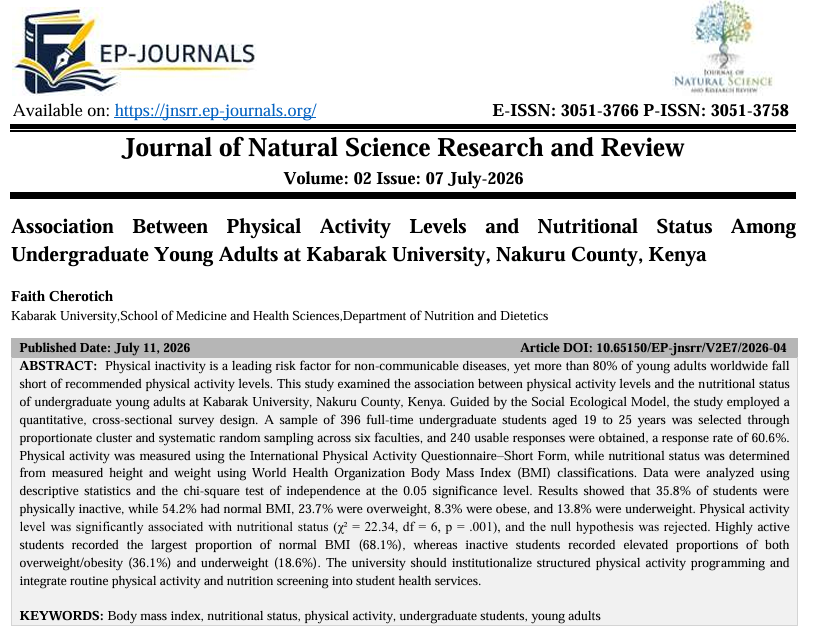
Physical inactivity is a leading risk factor for non-communicable diseases, yet more than 80% of young adults worldwide fall short of recommended physical activity levels. This study examined the association between physical activity levels and the nutritional status of undergraduate young adults at Kabarak University, Nakuru County, Kenya. Guided by the Social Ecological Model, the study employed a quantitative, cross-sectional survey design. A sample of 396 full-time undergraduate students aged 19 to 25 years was selected through proportionate cluster and systematic random sampling across six faculties, and 240 usable responses were obtained, a response rate of 60.6%. Physical activity was measured using the International Physical Activity Questionnaire–Short Form, while nutritional status was determined from measured height and weight using World Health Organization Body Mass Index (BMI) classifications. Data were analyzed using descriptive statistics and the chi-square test of independence at the 0.05 significance level. Results showed that 35.8% of students were physically inactive, while 54.2% had normal BMI, 23.7% were overweight, 8.3% were obese, and 13.8% were underweight. Physical activity level was significantly associated with nutritional status (χ² = 22.34, df = 6, p = .001), and the null hypothesis was rejected. Highly active students recorded the largest proportion of normal BMI (68.1%), whereas inactive students recorded elevated proportions of both overweight/obesity (36.1%) and underweight (18.6%). The university should institutionalize structured physical activity programming and integrate routine physical activity and nutrition screening into student health services.
References
1) Aira, T., Vasankari, T., Heinonen, O. J., Korpelainen, R., Kotkajuuri, J., Parkkari, J., Savonen, K., Uusitalo, A., Valtonen, M., Villberg, J., Vähä-Ypyä, H., & Kokko, S. P. (2021). Physical activity from adolescence to young adulthood: Patterns of change, and their associations with activity domains and sedentary time. International Journal of Behavioral Nutrition and Physical Activity, 18(1). https://doi.org/10.1186/s12966-021-01130-x
2) Bailey, C. P., Lowry, M., Napolitano, M., Hoban, M. T., Kukich, C., & Perna, F. M. (2022). Prevalence of physical activity requirements among US colleges/universities participating in the American College Health Association-National College Health Assessment II. Inquiry: The Journal of Health Care Organization, Provision, and Financing, 59. https://doi.org/10.1177/00469580221087891
3) Bull, F. C., Al-Ansari, S. S., Biddle, S., Borodulin, K., Buman, M. P., Cardon, G., Carty, C., Chaput, J.-P., Chastin, S., Chou, R., Dempsey, P. C., DiPietro, L., Ekelund, U., Firth, J., Friedenreich, C. M., Garcia, L., Gichu, M., Jago, R., Katzmarzyk, P. T., & Lambert, E. (2020). World Health Organization 2020 guidelines on physical activity and sedentary behaviour. British Journal of Sports Medicine, 54(24), 1451–1462. https://doi.org/10.1136/bjsports-2020-102955
4) Department of Health Services, Nakuru County. (2021). Nakuru County nutrition action plan (pp. 1–95).
5) Edelmann, D., Pfirrmann, D., Heller, S., Dietz, P., Reichel, J. L., Werner, A. M., Schäfer, M., Tibubos, A. N., Deci, N., Letzel, S., Simon, P., & Kalo, K. (2022). Physical activity and sedentary behavior in university students–the role of gender, age, field of study, targeted degree, and study semester. Frontiers in Public Health, 10(821703). https://doi.org/10.3389/fpubh.2022.821703
6) García-Hermoso, A., Izquierdo, M., & Ramírez-Vélez, R. (2021). Tracking of physical fitness levels from childhood and adolescence to adulthood: A systematic review and meta-analysis. Translational Pediatrics, 10(3), 474–484. https://doi.org/10.21037/tp-21-507
7) IPAQ Committee. (2005). International Physical Activity Questionnaire. http://www.ipaq.ki.se
8) Jurado-Gonzalez, P., López-Toledo, S., Bach-Faig, A., & Medina, F.-X. (2025). Barriers and enablers of healthy eating among university students in Oaxaca de Juarez: A mixed-methods study. Nutrients, 17(7). https://doi.org/10.3390/nu17071263
9) Milanese, C., Itani, L., Cavedon, V., & El Ghoch, M. (2025). The WHO BMI system misclassifies weight status in adults from the general population in North Italy: A DXA-based assessment study (18–98 years). Nutrients, 17(13). https://doi.org/10.3390/nu17132162
10) Mkuu, R., Barry, A., Yonga, G., Nafukho, F., Wernz, C., Gilreath, T., Chowdhury, M. A. B., & Harvey, I. S. (2021). Prevalence and factors associated with overweight and obesity in Kenya. Preventive Medicine Reports, 22(101340).
https://doi.org/10.1016/j.pmedr.2021.101340
11) Mogeni, B. K., & Ouma, L. O. (2022). Dietary patterns, behaviours, and their associated factors among university students in coastal Kenya. Cogent Food & Agriculture, 8(1). https://doi.org/10.1080/23311932.2022.2132873
12) Mugenda, O. M., & Mugenda, A. G. (2008). Research methods: Quantitative and qualitative approaches. Nairobi Acts Press.
13) Ndung’u, J., Kobia, J., & Waudo, J. N. (2025). Eating habits, physical activity and nutritional status among Kenyatta University students. Journal of Nutrition and Metabolism, 1–11. https://doi.org/10.1155/jnme/9951472
14) Nyanchoka, M. A., van Stuijvenberg, M. E., Tambe, A. B., Zuma, M. K., & Mbhenyane, X. G. (2022). Fruit and vegetable consumption patterns and risk of chronic diseases of lifestyle among university students in Kenya. International Journal of Environmental Research and Public Health, 19(12). https://doi.org/10.3390/ijerph19126965
15) Nyawornota, V. K., Adamba, C., Tay, D. A., Nyanyofio, O. C., Muomah, R. C., Chukwuorji, J. C., Nwonyi, S. K., Malete, L., Joachim, D., & Ocansey, R. T. (2024). Self-perception of health and physical activity levels among the youth and adults before and amidst the COVID-19 pandemic. Frontiers in Public Health, 12. https://doi.org/10.3389/fpubh.2024.1298378
16) Okeyo, A. P., Seekoe, E., de Villiers, A., Faber, M., Nel, J. H., & Steyn, N. P. (2020). Dietary practices and adolescent obesity in secondary school learners at disadvantaged schools in South Africa: Urban–rural and gender differences. International Journal of Environmental Research and Public Health, 17(16). https://doi.org/10.3390/ijerph17165864
17) Omer, I., Derese, T., & Sintayehu, Y. (2022). Overweight and its associated factors among women of reproductive age in Dire Dawa, Eastern Ethiopia, 2021: Community-based cross-sectional study. Journal of Obesity, 2022, 1–8. https://doi.org/10.1155/2022/7268573
18) Owusu, M. F., Adu, J., Dortey, B. A., Gyamfi, S., & Martin-Yeboah, E. (2023). Exploring health promotion efforts for non-communicable disease prevention and control in Ghana. PLOS Global Public Health, 3(9). https://doi.org/10.1371/journal.pgph.0002408
19) Sataloff, R. T., & Vontela, S. (2021). Response rates in survey research. Journal of Voice, 35(5).
https://doi.org/10.1016/j.jvoice.2020.12.043
20) Soares, E. M. K. von K., Molina, G. E., Saint Martin, D., Leitão, J. L. A. E. S. P., Fontana, K. E., Junqueira, L. F., de Araújo, T. L., Matsudo, S. M., Matsudo, V. K., & Porto, L. G. G. (2019). Questionnaire-based prevalence of physical activity level on adults according to different international guidelines: Impact on surveillance and policies. Journal of Physical Activity and Health, 16(11), 1014–1021. https://doi.org/10.1123/jpah.2018-0601
21) World Health Organization. (2022). The global status report on physical activity 2022. https://www.who.int/teams/health-promotion/physical-activity/global-status-report-on-physical-activity-2022
22) World Health Organization. (2023). Physical activity. https://www.who.int/initiatives/behealthy/physical-activity
23) World Health Organization. (2024). Physical activity. https://www.who.int/news-room/fact-sheets/detail/physical-activity
24) Zierle-Ghosh, A., & Jan, A. (2023). Physiology, body mass index. StatPearls Publishing.
Downloads
Published
Issue
Section
License
Copyright (c) 2026 Faith Cherotich (Author)

This work is licensed under a Creative Commons Attribution 4.0 International License.