Socioeconomic and Cultural Determinants of Biomass Briquette Adoption in Voi Sub-County, Taita Taveta County, Kenya
DOI:
https://doi.org/10.65150/EP-jnsrr/V2E3/2026-01Keywords:
biomass briquettes, clean cooking energy, sustainability, energy poverty, renewable energyAbstract
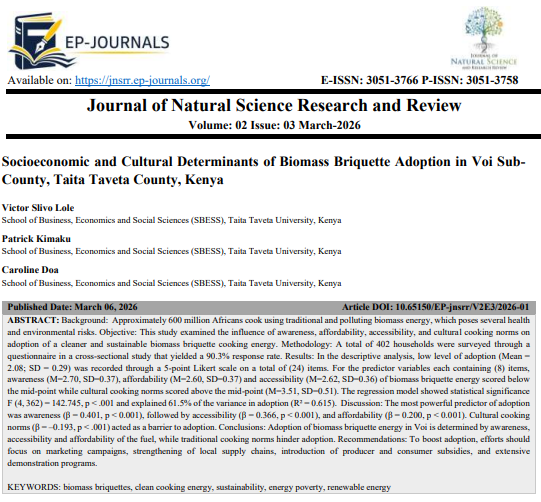
Background: Approximately 600 million Africans cook using traditional and polluting biomass energy, which poses several health and environmental risks. Objective: This study examined the influence of awareness, affordability, accessibility, and cultural cooking norms on adoption of a cleaner and sustainable biomass briquette cooking energy. Methodology: A total of 402 households were surveyed through a questionnaire in a cross-sectional study that yielded a 90.3% response rate. Results: In the descriptive analysis, low level of adoption (Mean = 2.08; SD = 0.29) was recorded through a 5-point Likert scale on a total of (24) items. For the predictor variables each containing (8) items, awareness (M=2.70, SD=0.37), affordability (M=2.60, SD=0.37) and accessibility (M=2.62, SD=0.36) of biomass briquette energy scored below the mid-point while cultural cooking norms scored above the mid-point (M=3.51, SD=0.51). The regression model showed statistical significance F (4, 362) = 142.745, p < .001 and explained 61.5% of the variance in adoption (R² = 0.615). Discussion: The most powerful predictor of adoption was awareness (β = 0.401, p < 0.001), followed by accessibility (β = 0.366, p < 0.001), and affordability (β = 0.200, p < 0.001). Cultural cooking norms (β = –0.193, p < .001) acted as a barrier to adoption. Conclusions: Adoption of biomass briquette energy in Voi is determined by awareness, accessibility and affordability of the fuel, while traditional cooking norms hinder adoption. Recommendations: To boost adoption, efforts should focus on marketing campaigns, strengthening of local supply chains, introduction of producer and consumer subsidies, and extensive demonstration programs.
References
1) Aemro, Y. B., Moura, P., & de Almeida, A. T. (2021). Inefficient cooking systems a challenge for sustainable development: a case of rural areas of Sub-Saharan Africa. Environment, Development and Sustainability, 23(10), 14697-14721.
2) Ahmed, S. K. (2024). How to choose a sampling technique and determine sample size for research: a simplified guide for researchers. Oral Oncology Reports, 12, 100662.
3) Almulhim, A. I. (2022). Understanding public awareness and attitudes toward renewable energy resources in Saudi Arabia. Renewable Energy, 192, 572-582.
4) Awan, A., Kocoglu, M., Subhan, M., & Shakib, M. (2025). Do energy intensity, resource abundance and inequality drive energy poverty? Evidence from developing countries. Geoscience Frontiers, 16(3), 102014.
5) Bircan Bodur, F. (2023). Firewood and Charcoal Demand in Sub-Saharan Africa: Assessing Sustainability and Trends. Available at SSRN 4518033.
6) Chowdhury, P., Mahi, N. A., Yeassin, R., Chowdhury, N. U. R., & Farrok, O. (2025). Biomass to biofuel: Impacts and mitigation of environmental, health, and socioeconomic challenges. Energy Conversion and Management: X, 25, 100889.
7) Clancy, J., Barnett, A., Cecelski, E., Pachauri, S., Dutta, S., Oparaocha, S., & Kooijman, A. (2019). Gender in the transition to sustainable energy for all: From evidence to inclusive policies.
8) Cochran, W. G. (1977). Sampling techniques. John Wiley & sons.
9) Connors Belopolsky, J. (2023, June 5). Fueling a Sustainable Future: The importance of clean cooking for a healthy environment. Clean Cooking Alliance.
10) County Government of Taita Taveta. (2018). County integrated development plan 2018-2022.
11) Dagnachew, A. G., Hof, A. F., Lucas, P. L., & van Vuuren, D. P. (2020). Scenario analysis for promoting clean cooking in Sub-Saharan Africa: Costs and benefits. Energy, 192, 116641.
12) Durbin, E. ., & Filer, J. (2021). Evaluating the Impact of Public Awareness Campaigns on Sustainable Practices. Journal of Energy and Environmental Policy Options, 4(4), 32-37.
13) Elasu, J., Ntayi, J. M., Orobia, L. A., Adaramola, M. S., & Onyinyi, B. (2025). Transforming cooking practices in Uganda: transitioning toward clean energy solutions. Frontiers in Sustainability, 6, 1567398.
14) Garba, I., & Bellingham, R. (2021). Energy poverty: Estimating the impact of solid cooking fuels on GDP per capita in developing countries of sub-Saharan Africa. Energy, 221, 119770.
15) Gill-Wiehl, A., Ray, I., & Kammen, D. (2021). Is clean cooking affordable? A review. Renewable and Sustainable Energy Reviews, 151, 111537.
16) Gupta, M. (2025). Hidden Ingredients: Examining the Influence of Gender and Culture on the Incomplete Adoption of Clean Cooking Fuels in India (Doctoral dissertation, University of Pennsylvania).
17) IEA (2022), SDG7: Data and Projections, IEA, Paris, License: CC BY 4.0
18) IEA (2023). A Vision for Clean Cooking Access for All, IEA, Paris, Licence: CC BY 4.0
19) Jagger, P., Bailis, R., Dermawan, A., Kittner, N., & Mccord, R. (2019). SDG 7: Affordable and Clean Energy – How Access to Affordable and Clean Energy Affects Forests and Forest-Based Livelihoods. Cambridge University Press EBooks, 206–236.
20) Jagger, P., & Das, I. (2018). Implementation and scale-up of a biomass pellet and improved cook stove enterprise in Rwanda. Energy for Sustainable Development, 46, 32-41.
21) Kanangire, R. R., Mbabazize, D. M., Shukla, J., & Wanderi, E. E. N. (2016). Determinants of adoption of improved biomass stove in rural households of Muhazi sector in Rwamagana district. European Journal of Business and Social Sciences, 5(06), 201-223.
22) Karanja, A., & Gasparatos, A. (2020). Adoption of improved biomass stoves in Kenya: a transect-based approach in Kiambu and Muranga counties. Environmental Research Letters, 15(2), 024020.
23) Kasangana, K. K., & Masekameni, D. M. (2019). Determinants for adoption and non-adoption of clean energy alternatives in low-income households: the case of South Africa. In 2019 International Conference on the Domestic Use of Energy (DUE) (pp. 8-15). IEEE.
24) Kemausuor, F., & Adu-Poku, A (2025). The Role of Bioenergy in Achieving SDG 7 in Africa.
25) Kenya Ministry of Energy. (2021). Energy compact of Kenya on clean cooking energy: A next decade action agenda to advance SDG7 on sustainable energy for all.
26) Kenya Population and Housing Census. (2019). Kenya National Bureau of Statistics, volume IV: Distribution of population by socio economic characteristics.
27) Kimani, M. N., Makindi, S. M., & Aboud, A. A. (2020). Knowledge and Awareness Determinants of Renewable Energy Technologies: A Cross Sectional Study of Rural Residents from Njoro Constituency, Nakuru County, Kenya.
28) Kimori, M., Juma, M., & Bongaerts, J. (2023). Exploring Factors Shaping Biogas Adoption Choices among Households in Taita Taveta County, Kenya. African Journal of Mining, Entrepreneurship and Natural Resource Management, 3(2), 263-270.
29) Kitheka, E., Kimiti, J. M., Oduor, N., Mutinda, J. W., Ingutia, C., & Githiomi, J. (2019). Factors influencing adoption of biomass energy conservation technologies in selected areas of Kitui County, Kenya.
30) Kizilcec, V., Perros, T., Bisaga, I., & Parikh, P. (2022). Comparing adoption determinants of solar home systems, LPG and electric cooking for holistic energy services in Sub-Saharan Africa. Environmental Research Communications, 4(7), 072001.
31) Kpalo, S. Y., Zainuddin, M. F., Manaf, L. A., & Roslan, A. M. (2020). A review of technical and economic aspects of biomass briquetting. Sustainability, 12(11), 4609.
32) Kumar, P., Dover, R. E., Díaz-Valdés Iriarte, A., Rao, S., Garakani, R., Hadingham, S., & Yadama, G. N. (2020). Affordability, accessibility, and awareness in the adoption of liquefied petroleum gas: a case-control study in rural India. Sustainability, 12(11), 4790.
33) Li, H., Li, Y., Zheng, G., & Zhou, Y. (2024). Interaction between household energy consumption and health: A systematic review. Renewable and Sustainable Energy Reviews, 189, 113859.
34) Mahoro, B. G., Eniru, E. I., Omuna, D., Akiyode, O., & Danson, M. (2022). Adoption of briquettes of organic matter as an environmentally friendly energy source in Uganda. KIU. J. Sci. Eng. Technol, 1(2022), 23-30.
35) Mignogna, D., Szabó, M., Ceci, P., & Avino, P. (2024). Biomass energy and biofuels: perspective, potentials, and challenges in the energy transition. Sustainability, 16(16), 7036.
36) Ministry of Energy and Petroleum. (2024). Kenya National Cooking Transition Strategy (KNCTS) 2024-2028 CASE STUDIES: Lessons Learnt from promoting clean cooking solutions in developing economies
37) Mokaya, D. C., Koske, J. K., Gichuki, C., Ngare, I. O., Kariuki, C. N., Kipkemoi, I., & Gickuki, L. (2020). Hindrances to adoption of biomass Briquettes technology as a climate change mitigation measure-case study of Maasai-Mau forest adjacent community, Kenya. International Journal of Renewable Energy Sources, 5.
38) Mugabi, P., & Kisakye, D. B. (2021). Status of production, distribution and determinants of biomass briquette acceptability in Kampala City, Uganda. Maderas. Ciencia y tecnología, 23.
39) Muwanga, R., & Mwiru, D. P. (2021). Social-cultural beliefs and behavioral intentions to adopt renewable energy technologies in Uganda. Business management review, 24(2), 16-32.
40) Ocen, S., Nkurunziza, G., Bagire, V., Echegu, S., Ssekakubo, J., & Atukunda, R. (2024). Unveiling factors influencing choice of clean cooking solutions among households: a systematic review of literature. Frontiers in Sustainability, 5, 1452900.
41) Okesiji, S. O. (2025). Decentralized renewable energy systems: A pathway to climate resilience in low-income regions. Sustainability and Climate Change, 18(2), 119-131.
42) Osano, A., Maghanga, J., Munyeza, C. F., Chaka, B., Olal, W., & Forbes, P. B. C. (2020). Insights into household fuel use in Kenyan communities. Sustainable Cities and Society, 55, 102039.
43) Quadrelli, J., Martin, R., Grassi, P., Rossi, G., Oom, S., & Vignati, J. (2022). CO2 emissions.
44) Röder, M., Chong, K., & Thornley, P. (2022). The future of residue-based bioenergy for industrial use in Sub-Saharan Africa. Biomass and Bioenergy, 159, 106385.
45) Rotich, I. K., Chepkirui, H., & Musyimi, P. K. (2024). Renewable energy status and uptake in Kenya. Energy Strategy Reviews, 54, 101453.
46) Simpson, N. P., Rabenold, C. J., Sowman, M., & Shearing, C. D. (2021). Adoption rationales and effects of off-grid renewable energy access for African youth: A case study from Tanzania. Renewable and Sustainable Energy Reviews, 141, 110793.
47) Stoner, O., Lewis, J., Martínez, I. L., Gumy, S., Economou, T., & Adair-Rohani, H. (2021). Household cooking fuel estimates at global and country levels for 1990 to 2030. Nature communications, 12(1), 5793.
48) Tamire, M., Addissie, A., Skovbjerg, S., Andersson, R., & Lärstad, M. (2018). Socio-cultural reasons and community perceptions regarding indoor cooking using biomass fuel and traditional stoves in rural Ethiopia: a qualitative study. International journal of environmental research and public health, 15(9), 2035.
49) Tereka, S., Pétursson, J. G., Byakagaba, P., & Ingólfsdóttir, A. H. (2025). Gender and socio-economic determinants of rural household adoption of clean energy practices in Uganda: Implications for energy transition pathways. Energy for Sustainable Development, 88, 101780.
50) The Energy Progress Report (2022). ACCESS TO CLEAN FUELS AND TECHNOLOGIES FOR COOKING.
51) Thoronka, J. (2025). GENDERED ENERGY CULTURES AND CLEAN COOKING IN KIGALI: STATUS, TASTE, AND FUEL STACKING. Veredas do Direito, 22(4), e223717-e223717.
52) United Nations. (2024). Progress Towards the Sustainable Development Goals. In United Nations (pp. 1–26). United Nations.
53) United Nations. (2019). Department of Economic and Social Affairs Population Division Patterns and trends in household size and composition: Evidence from a United Nations dataset.
54) Vigolo, V., Sallaku, R., & Testa, F. (2018). Drivers and barriers to clean cooking: a systematic literature review from a consumer behavior perspective. Sustainability, 10(11), 4322.
55) Waswa, F., Mcharo, M., & Mworia, M. (2020). Declining wood fuel and implications for household cooking and diets in tigania Sub-county Kenya. Scientific African, 8, e00417.
56) Yustas, Y. M., Tarimo, W. M., Mbacho, S. A., Kiobia, D. O., Makange, N. R., Kashaija, A. T., & Silungwe, F. R. (2022). Likelihood of adopting briquette technology in abundance of competitive energy sources: a case study of Morogoro urban and rural districts, Tanzania.
Downloads
Published
Issue
Section
License
Copyright (c) 2026 Victor Slivo Lole, Patrick Kimaku, Caroline Doa (Author)

This work is licensed under a Creative Commons Attribution 4.0 International License.