Chromatin-Optimized Crispr Activation for Enhanced Pollutant Degradation in Rhodococcus Consortia
DOI:
https://doi.org/10.65150/EP-jnsrr/V2E8/2026-01Keywords:
Bioremediation, Crispra, Chromatin, Microbial Consortia, Pollutant Degradation, Synthetic MetabolismAbstract
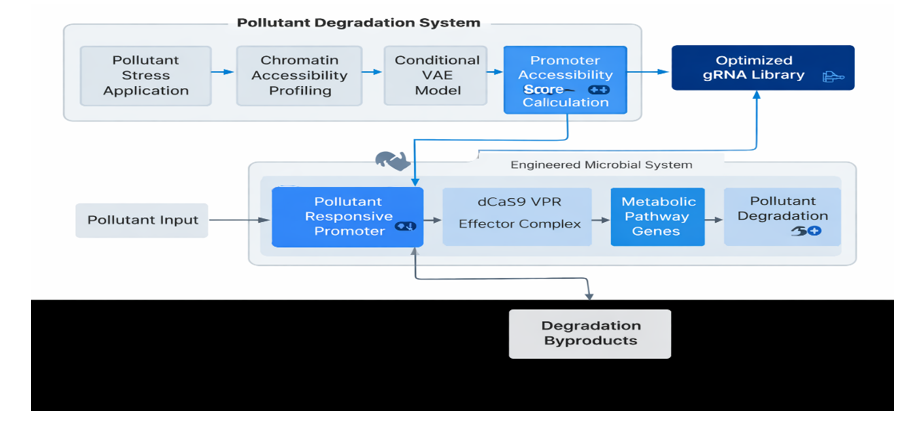
The system we are introducing allows for dynamic transcriptional targeting through an optimized CRISPR activation (CRISPRa) system that will improve the ability of Rhodococcus consortia to degrade pollutants. The majority of metabolic engineering approaches to date do not take into consideration chromatin silencing as a source of surprise that may result in unexpected transcriptional regulation of metabolic pathways within non-model organisms. The proposed approach combines chromatin accessibility profiling with a conditional variational autoencoder (cVAE) model to identify Nuclease-depleted regions (NDR's) that are chronically available for interaction with dCas9-VPR complexes to activate target downstream GbN for sustained transcriptional activation of the GbN in response to dynamic increases in pollutant concentration. Where stable NDR's proximal to key metabolic enzyme genes are identified by the cVAE as being stable chromatin, an NDR's proximity to a key metabolic enzyme locus can be used to identity likely site(s) for placement of dCas9-VPR complexes for sustained activation of the enzyme system. To prioritize the metabolically active NDR's, a provided Promoter Accessibility Score was calculated to account both local and distal regulatory controls on each NDR to identify the optimum transcriptional initiating site (TIS) for a final targeted dCas9-VPR complex placement. A plasmid-cloned, delivered CRISPRa system was developed to validate pathway function; this system provided dCas9-VPRtmp and gRNA's that were formulated for pollution-specific use, coupled with Codon-Optimized effectors, for use in metabolic pathway activation and evaluation by quantitative measures, including improvement in degradation rates of hydrocarbons as well as poly-aromatic hydrocarbons through a rated time course experiment. Ultimately, the proposed cVAE based CRISPRa system will be able to provide real-time adaptability to changes in the environment, setting the cVAE based CRISPRa apart from static dual-promoter based systems to create a greater degree of Flexibility in the metabolic response of Microbial consortia associated with biodegradation as well as bioremediation applications. This work demonstrates the relationship between Chromatin Biology and Synthetic Metabolism and provides a scalable, rapidly adaptable bioremediation system that can be ascribed with a robust response capability to fluctuations in Environmental input and ongoing target gene product variation, such as are present within non-model organisms over extended time periods, a feature that is critical to achieving desirable levels of genetic stability during bioprocessing for bioremediation and biodegradation.
References
1) Cantin, L. J., Dunning Hotopp, J. C., & Foster, J. M. (2024). Improved metagenome assemblies through selective enrichment of bacterial genomic DNA from eukaryotic host genomic DNA using ATAC-seq. Frontiers in Microbiology, 15. https://doi.org/10.3389/fmicb.2024.1352378
2) Cho, S., Shin, J., & Cho, B.-K. (2018). Applications of CRISPR/Cas System to Bacterial Metabolic Engineering. International Journal of Molecular Sciences, 19(4), 1089. https://doi.org/10.3390/ijms19041089
3) DaSilva, L. F., Senan, S., Patel, Z. M., Reddy, A. J., Gabbita, S., Nussbaum, Z., Córdova, C. M. V., Wenteler, A., Weber, N., Tunjic, T. M., Khan, T. A., Li, Z., Smith, C., Bejan, M., Louis, L. K., Cornejo, P., Connell, W., Wong, E. S., Meuleman, W., & Pinello, L. (2024). DNA-Diffusion: Leveraging Generative Models for Controlling Chromatin Accessibility and Gene Expression via Synthetic Regulatory Elements. Biorxiv. https://doi.org/10.1101/2024.02.01.578352
4) Duncker, K. E., Holmes, Z. A., & You, L. (2021). Engineered microbial consortia: strategies and applications. Microbial Cell Factories, 20(1). https://doi.org/10.1186/s12934-021-01699-9
5) Fontana, J., Dong, C., Kiattisewee, C., Chavali, V. P., Tickman, B. I., Carothers, J. M., & Zalatan, J. G. (2020). Effective CRISPRa-mediated control of gene expression in bacteria must overcome strict target site requirements. Nature Communications, 11(1). https://doi.org/10.1038/s41467-020-15454-y
6) Gancedo, J. M. (1998). Yeast Carbon Catabolite Repression. Microbiology and Molecular Biology Reviews, 62(2), 334–361. https://doi.org/10.1128/mmbr.62.2.334-361.1998
7) Grandi, F. C., Modi, H., Kampman, L., & Corces, M. R. (2022). Chromatin accessibility profiling by ATAC-seq. Nature Protocols, 17(6), 1518–1552. https://doi.org/10.1038/s41596-022-00692-9
8) Hajiahmadi, Z., Movahedi, A., Wei, H., Li, D., Orooji, Y., Ruan, H., & Zhuge, Q. (2019). Strategies to Increase On-Target and Reduce Off-Target Effects of the CRISPR/Cas9 System in Plants. International Journal of Molecular Sciences, 20(15), 3719. https://doi.org/10.3390/ijms20153719
9) Ho, H., Fang, J. R., Cheung, J., & Wang, H. H. (2020). Programmable CRISPR‐Cas transcriptional activation in bacteria. Molecular Systems Biology, 16(7). https://doi.org/10.15252/msb.20199427
10) Keung, A. J., Joung, J. K., Khalil, A. S., & Collins, J. J. (2015). Chromatin regulation at the frontier of synthetic biology. Nature Reviews Genetics, 16(3), 159–171. https://doi.org/10.1038/nrg3900
11) Kim, N. M., Sinnott, R. W., & Sandoval, N. R. (2020). Transcription factor-based biosensors and inducible systems in non-model bacteria: current progress and future directions. Current Opinion in Biotechnology, 64, 39–46. https://doi.org/10.1016/j.copbio.2019.09.009
12) Leavitt, J. M., & Alper, H. S. (2015). Advances and current limitations in transcript-level control of gene expression. Current Opinion in Biotechnology, 34, 98–104. https://doi.org/10.1016/j.copbio.2014.12.015
13) Ling, H., Teo, W., Chen, B., Leong, S. S. J., & Chang, M. W. (2014). Microbial tolerance engineering toward biochemical production: from lignocellulose to products. Current Opinion in Biotechnology, 29, 99–106. https://doi.org/10.1016/j.copbio.2014.03.005
14) Liu, P., Chen, M., Liu, Y., Qi, L. S., & Ding, S. (2018). CRISPR-Based Chromatin Remodeling of the Endogenous Oct4 or Sox2 Locus Enables Reprogramming to Pluripotency. Cell Stem Cell, 22(2), 252–261.e4. https://doi.org/10.1016/j.stem.2017.12.001
15) Liu, R.-Y., Li, B.-Z., Yuan, Y.-J., & Liu, Z.-H. (2025). Multiscale metabolic engineering in biological lignin valorization. The Innovation, 6(11), 100993. https://doi.org/10.1016/j.xinn.2025.100993
16) Lü, H., Wei, J.-L., Tang, G.-X., Chen, Y.-S., Huang, Y.-H., Hu, R., Mo, C.-H., Zhao, H.-M., Xiang, L., Li, Y.-W., Cai, Q.-Y., & Li, Q.
X. (2024). Microbial consortium degrading of organic pollutants: Source, degradation efficiency, pathway, mechanism and application. Journal of Cleaner Production, 451, 41913. https://doi.org/10.1016/j.jclepro.2024.141913
17) Mishra, P., & Chan, D. C. (2016). Metabolic regulation of mitochondrial dynamics. Journal of Cell Biology, 212(4), 379–387. https://doi.org/10.1083/jcb.201511036
18) Morrison, A. J. (2020). Chromatin-remodeling links metabolic signaling to gene expression. Molecular Metabolism, 38, 100973. https://doi.org/10.1016/j.molmet.2020.100973
19) Movahedi, A., Aghaei-Dargiri, S., Li, H., Zhuge, Q., & Sun, W. (2023). CRISPR Variants for Gene Editing in Plants: Biosafety Risks and Future Directions. International Journal of Molecular Sciences, 24(22), 16241. https://doi.org/10.3390/ijms242216241
20) Naik, R. R., Tiihonen, A., Thapa, J., Batali, C., Liu, Z., Sun, S., & Buonassisi, T. (2022). Discovering equations that govern experimental materials stability under environmental stress using scientific machine learning. Npj Computational Materials, 8(1). https://doi.org/10.1038/s41524-022-00751-5
21) Nicolas, D., Phillips, N. E., & Naef, F. (2017). What shapes eukaryotic transcriptional bursting?. Molecular Biosystems, 13(7), 1280–1290. https://doi.org/10.1039/c7mb00154a
22) Noonan, J. P., & McCallion, A. S. (2010). Genomics of Long-Range Regulatory Elements. Annual Review of Genomics and Human Genetics, 11(1), 1–23. https://doi.org/10.1146/annurev-genom-082509-141651
23) S. W. Cho, T. Kim, J. Yang, G. Byun, and S. W. Seo, “Multiplexed CRISPR base editing enables pulse-activated irreversible biocontainment of engineered bacteria,” Nucleic Acids Research, vol. 54, no. 8, pp. gkag422, May 2026. DOI: 10.1093/nar/gkag422
24) Reddy, S. R., Bangeppagari, M., & Lee, S. J. (2025). Immune–Epigenetic Effects of Environmental Pollutants: Mechanisms, Biomarkers, and Transgenerational Impact. Current Issues in Molecular Biology, 47(9), 703. https://doi.org/10.3390/cimb47090703
25) Senthil-Kumar, M., Rame Gowda, H. V., Hema, R., Mysore, K. S., & Udayakumar, M. (2008). Virus-induced gene silencing and its application in characterizing genes involved in water-deficit-stress tolerance. Journal of Plant Physiology, 165(13), 1404–1421. https://doi.org/10.1016/j.jplph.2008.04.007
26) Shahab, R. L., Brethauer, S., Davey, M. P., Smith, A. G., Vignolini, S., Luterbacher, J. S., & Studer, M. H. (2020). A heterogeneous microbial consortium producing short-chain fatty acids from lignocellulose. Science, 369(6507). https://doi.org/10.1126/science.abb1214
27) C. M. Hustmyer and R. Landick, “Bacterial chromatin proteins, transcription, and DNA topology: inseparable partners in the control of gene expression,” Molecular Microbiology, vol. 122, pp. 81–112, Jan. 2024. DOI: 10.1111/mmi.15283
28) Wan, J., Oliver, V. F., Wang, G., Zhu, H., Zack, D. J., Merbs, S. L., & Qian, J. (2015). Characterization of tissue-specific differential DNA methylation suggests distinct modes of positive and negative gene expression regulation. BMC Genomics, 16(1). https://doi.org/10.1186/s12864-015-1271-4
29) Wang, Y., Wang, H., Wei, L., Li, S., Liu, L., & Wang, X. (2020). Synthetic promoter design in Escherichia coli based on a deep generative network. Nucleic Acids Research, 48(12), 6403–6412. https://doi.org/10.1093/nar/gkaa325
30) Z. Herceg, A. Ghantous, T. Gheit, F. R. Talukdar, C. Matar, F. Chung, M. Korenjak, J. Zavadil, L. F. R. Pinto, and R. C. Fry, “Cancer epigenetics: unraveling etiology and mechanisms to advance prevention,” JNCI Monographs, vol. 2026, no. 72, pp. 44–58, Apr. 2026. DOI: 10.1093/jncimonographs/lgaf044
31) Wu, G., Yan, Q., Jones, J. A., Tang, Y. J., Fong, S. S., & Koffas, M. A. G. (2016). Metabolic Burden: Cornerstones in Synthetic Biology and Metabolic Engineering Applications. Trends in Biotechnology, 34(8), 652–664. https://doi.org/10.1016/j.tibtech.2016.02.010
32) Xia, Y., Sun, J., Du, X., Liang, Z., Wu, X., Shi, W., Shao, B., Guo, S., & Huo, Y.-X. (2026). Design prokaryotic cis-regulatory elements using language model. Nucleic Acids Research, 54(4). https://doi.org/10.1093/nar/gkag122
33) Xie, W. J., Qi, Y., & Zhang, B. (2020). Characterizing chromatin folding coordinate and landscape with deep learning. Plos Computational Biology, 16(9), e1008262. https://doi.org/10.1371/journal.pcbi.1008262
34) M. Kepa, M. Nielipinski, E. Widawska, J. Filipek, N. Kazmierczak, J. Sosnowska, K. Baca, M. Nastarowicz, M. Rupp, M. Goslawski-Zeligowski, J. Mokrzycka, D. Nielipinska, B. Sekula, and A. J. Pietrzyk-Brzezinska, “Conserved motifs in the ligand-binding domain of TetR family regulators: identification and analysis,” Computational and Structural Biotechnology Journal, vol. 35, no. 1, p. 0100, May 2026. DOI: 10.34133/csbj.0100
35) Zhang, T., & Zhang, H. (2022). Microbial Consortia Are Needed to Degrade Soil Pollutants. Microorganisms, 10(2), 261. https://doi.org/10.3390/microorganisms10020261
36) Zhu, X., Zhang, Z., Jia, B., & Yuan, Y. (2023). Current advances of biocontainment strategy in synthetic biology. Chinese Journal of Chemical Engineering, 56, 141–151. https://doi.org/10.1016/j.cjche.2022.07.019
Downloads
Published
Issue
Section
License
Copyright (c) 2026 Sebastian, Jeremia D., Akpadolu, Chidinma B, Benin, Sandra, Okoye, Rosemary, Owusu, Nana H. (Author)

This work is licensed under a Creative Commons Attribution 4.0 International License.